Intro to Pedals Part 5: Signal Chain

Effective pedal order is a subject that used to be treated as a great mystery, as though the correct signal path for each guitarist can only be known by them exclusively, and even then only after some kind of mystical revelation.

That’s absolute rubbish of course. People have been experimenting with their signal chains for decades now, common results have been documented, and a rough idea of best practice has been arrived at. In this post we’ll go over what that “best practice” looks like, why it works the way it does, and help you decide if, when, and how to “break the rules” so to speak.

Let’s get into it.

Standard Practice

Pitch

First of all, anything that needs to track the pitch of your guitar should get the cleanest, most unadulterated signal that it can if you want it to have a sporting chance of doing its job properly. By this I’m referring to your tuner, pitch shifters like the Digitech Drop and Whammy, and perhaps even octave pedals.


Gain

After that, it’s a good idea to have your drive section towards the start of the chain. This includes fuzz, overdrive, boost, and distortion.

Drive pedals typically define your EQ and gain level, which form the core, fundamental part of your tone. From that perspective it makes sense to establish this first before letting other pedals do freaky things with your core tone later in the chain.

Putting drive pedals after other pedals can radically change the way they sound. There are definitely situations where that can sound cool, but we’ll cover those later. For now let’s keep things fairly simple and vanilla.


Modulation

Next in the chain would be modulation pedals. This is the wobbly stuff:

  • Vibrato (modulates your pitch up and down rhythmically)
  • Chorus (splits your signal in two and applies vibrato to one of them)
  • Phaser (splits your signal in two and moves them in and out of phase with each other)
  • Flanger (splits your signal in two and adds a subtle delay to one of them, creating a swooshing effect)
  • Tremolo (modulates your volume up and down, creating a shimmery or choppy sound).

Modulation pedals add character and create a sense of movement to the core tone you established in your drive section.


Time

After modulation we deal with time and space via delay and reverb. The idea of these is to take your whole signal and make it sound like it’s echoing back from or reverberating off the walls of a large space. For that reason you might want to send all of your effects into these.


The Fight for Last Place

Given that tremolo works by rhythmically dropping your volume, it’s possible that reverb tails or delay repeats which fall in that otherwise silent space might counteract the feel of it. For this reason, some people like to put tremolo at the end of their chain.

Then again, putting tremolo after delay creates the possibility of that silence coinciding with delay repeats, making it feel as though the delay isn’t turned on at all. The other possibility is your dry signal being silenced by the tremolo and only allowing the repeats through. The most likely scenario would be a mess of both. Best to experiment if you want to use delay and tremolo at the same time.


The Fight for First Place

For all their tough-guy image, some fuzz pedals can be total princesses about their input impedance. This means if they’re not the very first pedal in your chain they can behave like a spoilt brat.

Wah pedals typically go before your drive section to function properly, so if you have temperamental fuzz, you might have some experimenting and prioritising ahead of you. You’re in for a real headache if you have a fussy fuzz, a wah pedal, and a pitch-based effect that you intend on using at the same time.

The big picture looks something like this:
Pitch – Gain – Modulation – Time

I’ve seen some people on guitar forums post the chart below from Roland, stating that it’s all you need to know on the subject of signal chain. As we’ve just seen though, it’s not that simple.

There are a few issues that make it not terribly helpful for new guitarists trying to get their heads around signal chain issues:

  • It makes no attempt to include a fuzz
  • It does not tackle the tremolo dilemma
  • It includes a Metal Zone. Honestly, what kind of message are they trying to send to new guitarists? What’s next? Handing out crack at a kindergarten?


Gain Stacking

Hopefully you’ve now got a decent idea of standard practice for the order of most pedal types. Within your drive section though, you might have a bunch of different types of gain pedals. Let’s have a look at how you might want to order them.

Just in case your fuzz pedal is the sort of entitled infant that will throw a hissy fit if it’s not first in line, we’re going to give it what it wants: Fuzz first.
Of course you love your Fuzz. It’s ok to feel sick of its bullshit from time to time.

From there though, you need to consider what you want your drive pedals to do.

If you want one pedal to provide a volume lift for another, you would place the heavier gain pedal first and the lighter gain pedal second. Order your drives from heaviest to lightest to get a big, high headroom drive sound.

If you want one pedal to add more distortion to another, you would place the lighter gain pedal before the heavier one. Order your drives from lightest to heaviest to end up with a chain of cascading nastiness.


Breaking the Rules

The number one piece of advice handed out to people who ask about pedal order is to “try it out for yourself”. Fortunately for you I’m not a complete asshole, and I acknowledge what a pain it can be to completely re-route your pedal board just to see what will happen. In this next part I’m going to try to explain the most likely outcome should you stray from standard practice.

That’s not to say you shouldn’t experiment. No one’s going to call the cops if you put your reverb first in your chain and your fuzz pedal last. There’s a pretty good chance you won’t enjoy the outcome, but you are of course free to do what you want. Experimenting and listening will no doubt give you a much better perspective than reading about it in a blog post.

Gain after Modulation

Placing drive after another kind of pedal will take its signal and compress it, smoothing it out and making it more consistent. With modulation, that kind of defeats the purpose.

Then again, maybe you have a modulation pedal that’s a little bit drastic for your tastes. Putting a subtle overdrive after it could tame it nicely. This would be a sensible reason to put drive after modulation.

Having said that, putting a killer high-gain metal distortion after modulation probably won’t be as kick-ass as you’re hoping. The distortion would sound more impressive with a clean signal going into it, and would only work to minimise and muddy-up the modulation.


Gain after Delay

Delay repeats typically decay or get quieter as they go on. If you put a drive pedal after it though, the compression will interfere with that decay. Repeats will continue for longer and potentially crash into each other. It’s a big, chaotic noise that might be fun to play with, but not what most folks have in mind when they reach for a delay pedal.

A slap back delay (one repeat with an extremely short delay time) can work either side of a drive without issue.


Gain after Reverb

Similar to the issue with repeat decay in delay pedals, putting a drive pedal after reverb will make the reverb tails carry on longer and create a big, chaotic noise. Again, fun to play with, but practically unusable unless you’re in a shoe-gazer band or avant garde noise act.


Using the Effects Loop

If your amp is already breaking up without the use of drive pedals, then your amp is acting like an overdrive pedal at the end of your chain. If you’ve taken anything from this article so far you’ll know this could be problematic.

While there’s probably a whole article I could write about how amps work, for now let’s just look at the two main parts: the pre amp and the power amp.

The pre amp sets the gain and EQ of your signal before handing it over to the power amp, which makes the whole thing louder. It’s the pre amp which is likely causing your amp to overdrive.
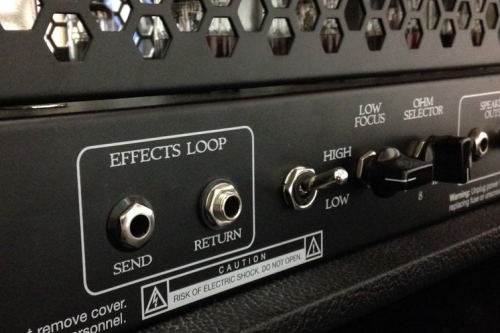
An effects loop lets you plug a few pedals between your pre amp and power amp. If you use your pre amp for your drive sounds, you can still maintain your signal chain by putting your modulation, delay, and reverb pedals in the loop.


What about a Phrase Looper?

There’s often confusion about where to put a loop pedal. These typically go at the end of your chain before your amp so they can catch everything, but again, you don’t have to do what everyone else does. Just remember that it will record anything you put in front of it, and its playback will be affected by anything you put after it.


Where Do I Put My EQ Pedal?

Put your EQ pedal wherever you feel the EQ correction needs to be made. If you’re trying to counteract a tonal quality of a specific pedal (like put some mids back in if you’re using a Muff, or bottom end if you’re using a Tube Screamer) put the EQ immediately after the pedal in question.

EQs can be fun to play with in your drive section. Just turning the level up can make it work like a boost. Cranking a specific frequency before sending your signal into a drive pedal will make that frequency overdrive more.


That’s All For Now

Hopefully that should cover most of the common questions that pop up around all things signal chain.

If I could impart any advice on the subject it would be to have a clear idea in mind about what you want to achieve before you start plugging things in, to save a lot of mucking around. Also, having said that, feel free to experiment and let your ears guide you.

Oh, and if you see this guy lurking around outside your school trying to sell Metal Zones: JUST SAY NO!

Intro to Pedals Part 2: Choosing Pedals

So you’ve decided that you want more from your guitar sound than what you get when you plug straight into your amp. It’s time to get a pedal or two, but which ones should you be checking out to begin with?

Multi Effects Units

A fairly common way to get an idea of what’s what, is to get hold of a multi effects unit which supposedly has everything in it. It’s significantly cheaper than buying one of every kind of pedal in existence, and side steps having to deal with mounting them to a board, hooking up lots of patch cables and worrying about power requirements.

If you have access to one of these, maybe on loan from someone else or acquired second hand for some freakishly negligible cost, it might be helpful to play with. You can scroll through all the effects while making an awful racket and taking note of which ones you find interesting.

I’ll stop short of recommending you spend significant money on one of these units, or spend a significant amount of time trying to sculpt a usable combination of sounds with one. I would strongly discourage buying a new one at full retail price.

What will inevitably happen is, over time you’ll discover at least 60% of the sounds in that unit are of no interest to you, and those that are happen to be important enough to you that you want a decent quality version of that effect in an individual pedal. I can’t think of a single guitar player who started out with a multi effects unit and went on to use it exclusively throughout their professional career.

Resale value on these things can be punishingly low, so selling it on once you’re done with it seems hardly worth it. This is not where you want to invest the bulk of your gear budget.

Having said all that, many professional musicians do occasionally gig with top quality modelling gear when they’re travelling light or they don’t want to take their expensive vintage equipment to a particular gig. Worthy of note among these are the Line 6 Helix range, and Neural DSP Quad Cortex.

Those aren’t cheap though, and for the same or less money you could buy one of the actual amps or some of the effects that they’re trying to sound like. Why not have the real thing? When you buy modelling equipment you’re paying for access to a vast range of sounds, most of which you’ll never use.

This brings us to the most important question you need to keep in mind when shopping for pedals: “What are the effects I need in order to generate the guitar sounds I want to play?”

Knowing What to Use

Put together a playlist of the kind of music that you’re likely to play on guitar. Listen to what effects the guitarists in those recordings are using. This will be your starting point. I’m going to make a few suggestions here but you don’t necessarily need these pedals to play that music.

Get a Tuner

OK forget what I just said about not needing the pedals I suggest here. Every guitarist needs a tuner, and that means you, too. Pedal tuners are about the most practical on the market. When you consider the alternatives are either rack mounted, headstock/clip on tuners, or a pitch pipe, this just makes sense.

Important things to look for in a tuner are:

  • Accuracy
  • Tracking speed (when you pluck a note, you don’t want to have to wait for the tuner to “find” it)
  • Visibility in different lighting situations (consider dark/low light in a club versus bright sunlight at an outdoor gig)

The TC Electronic Polytune is hugely popular, and for what it’s worth I’m a big fan of the Korg Pitchblack Custom. While the visibility isn’t quite as impressive as the Custom version, the standard Korg Pitchblack performs much the same and costs a fair bit less.

You don’t have to spend a fortune on a multitude of features here, but you only want to have to make this purchase once and be done with it. This isn’t a fun or exciting pedal, and if you cheap out on something that’s a massive compromise, you might find yourself going through the banality of shopping for another one in the not-too-distant future. There’s no such thing as a “beginners tuner” so you might as well make the investment in a proper one straight away.

Your Average Rock Band

Straight away you’re going to need some sort of overdrive, and it’s quite likely you’ll only need one. If you’re going to play the odd lead break, you may want to also invest in a lead boost. That would sort most rock guitarists out, and this is reflected in the amount of “dual overdrives” on the market (essentially an overdrive with a second switch to engage a boost).

It’s not all that uncommon to want to make use of several different gain stages:

  • a light, just-past-edge-of-break-up overdrive
  • a more aggressive, higher gain overdrive
  • a lead boost

Stacking all of those into each other could also approximate a decent full-fat distortion in a pinch.

Your Average Covers Band

Covers bands play a bit of everything, so surely you’re going to have to get the lot, right? Not necessarily.

Assuming your amp already has reverb, you’ll be surprised just how far you can get with a range of different gain stages (see above) and a delay pedal.

Depending on the material you’ll be covering, you may want to get some sort of modulation. Most commonly this will be chorus and tremolo, but occasionally you may need a flanger/phaser/vibrato etc.

If you’re doing 60s rock covers, you’ll want to get a wah pedal, a fuzz, and maybe a uni-vibe.

The Heavy Stuff

If you’re playing heavy music, some kind of distortion is a must. A lot of metal guitarists will achieve this via an amp with a high gain channel. If you take this route, it’s still worth looking at some kind of lead boost. Consider how loud it is when the rest of the band is pummelling out a down-tuned heavy riff at full volume. Your tiny little single note lines don’t stand a chance of being heard in that mix without some kind of assistance.

Stepping on a Tube Screamer or some kind of Tube Screamer derivative at this point would help a great deal. It would tighten up your bottom end, increase your mids, and in doing so raise your most audible frequencies so the audience can hear you. If you crank the level knob you’ll also enjoy a cheeky increase in overall volume. Most lead boosts will operate like this: they’ll likely lift your upper mids and increase your volume.

If you don’t have a high gain amp, you’re going to need a distortion pedal. There are so many types of distortion pedal on the market I could dedicate an entire series of posts just on this topic. I’ll try to give you a quick over view to get you started on your search.

The good old fashioned Boss DS-1 was a go-to pedal in the 80s but is a bit too shrill and spikey sounding for some rigs. Dialling the tone knob all the way back on one of these might get you the exact sound you’re after without spending a whole lot. A Rat might be worth a look if you want something old school but a bit darker and thicker sounding. They’re kind of a cross between a DS-1 and a Fuzz Face.

If sludgy, doomy, fuzz-meets-distortion is what you’re after, check out the world of Big Muffs. There’s a lot of variation between the different Muffs available, so do your research and try a few out.

If you’re chasing a more modern, djenty sound, there’s quite a lot of options. Check out Deizel pedals for starters. This company is renowned for making epic sounding high gain amps, and they’ve done a decent job of capturing that distortion sound in their pedals.

James Brown (no, not that one, the guy responsible for the design of the Peavey 5150) now has a pedal company by the name of Amptweaker. His distortion pedals are next-level awesome. The MXR 5150 overdrive pedal is geared towards the distortion sound of that amp, and like the Amptweaker stuff, comes with a built in noise gate.

Music hasn’t sounded quite the same since either of these two guys came along.

If you’re looking to spend a little less, there’s the Hotone Djent. It looks like a toy but sounds like the business.

Conclusion

These are all just broad suggestions on where to start if you’re not sure. Whatever you run with for your first pedals, get cheap ones to start with.

Yes, I would discourage spending good money on a multi effects unit to try it all out, on the basis that you’ll probably move on from it and not get your money back. I will however encourage you to take a similar approach with a handful of cheap pedals instead. You might experience a few less effects, but you lose less money and focus on the more relevant pedals to your playing style.

While you figure out what flavour of overdrive or fuzz or distortion etc you’re into, you’re going to swap out and trade your way through a whole bunch of pedals. Better to do that with cheap ones first of all. Even if you start with expensive pedals, you can still be almost certain you’ll end up moving them on at a loss once you refine your tonal tastes.

Here’s how I’d recommend the commencement of your pedal journey:

  • Listen closely to recordings of the genre of music you’d like to play
  • Take note of the effects involved
  • Buy some cheap versions of those effects
  • Once you know what sort of sounds you like, have a look at which pedals on the market do a top notch version of that sound within your budget

Just a word of warning: once you start experimenting with pedals, it’s a slippery slope towards full blown pedal addiction. You’ll quickly find all sorts of pathetic excuses to spend more than you should on just one more pedal. Always keep in mind what you’re trying to achieve with your tone before you browse for pedals, and likewise keep a close eye on your budget. You have been warned.

Once you’ve got a handful of pedals you’ll be wanting to hook them all up in a practical and portable manner. In my next post I’ll be exploring all the non-pedal parts of your floor based gear: pedal boards, patch leads, power requirements, and other stuff you could potentially lose a heap of money on through buying the wrong gear or cutting costs in the wrong area. This post will cover all the hidden expenses we forget about while lusting after the gear that makes cool sounds.