In the world of high gain guitar sounds we have boost, overdrive, distortion, and fuzz.
Boost can add a little gain and EQ shaping with a bit of a kick in volume.
Overdrive was born from the sound of an amp literally being driven too hard. This term could cover anything from an almost clean edge-of-break-up sound, to a cranked Marshall sound.
Distortion is a bit like overdrive on steroids, with more aggressive clipping and more compression.
Fuzz is a different thing altogether. This is where we encounter some of the harshest “square wave” clipping available.
Then there’s the grey area where these overlap. When these sounds were initially discovered there were no clear distinctions between them. Some boosts creep into overdrive territory. Some overdrives could just as easily be described as distortion, or dialed back and used as a boost. There are at least a handful of pedals around where internet debates continue to rage over whether they’re distortion or fuzz.
Overdrive Pedal Types
The number of overdrive pedals on the market right now is staggering. If you took one of each model and piled them on top of each other, you could use it as a bridge to Mars and save Elon Musk a lot of bother.

Mercifully though, many of them fall into categories which help when you’re comparing them to decide what you’re after. Let’s take a look at a few.
Tube Screamers
Ibanez brought out the tube screamer as an overdrive pedal designed not so much to bring all the crunch on its own, but to push the front end of a tube amp into its own overdrive. It dumps your bottom end and cranks your mid range right up, with some mild clipping for good measure.
Some folks use these after their regular overdrive or distortion as a lead boost. Others use it before their distortion to clean up an otherwise boomy bottom end. You’ll often see these in front of a Peavey 5150/6505 or Mesa Boogie Dual Rectifier in metal bands for this reason.
- First there was the TS808 described above (and the small version, the Tube Screamer Mini).
- Then the TS9, a bit brighter and harsher sounding, and arguably more aggressive.
- The TS9DX which was a TS9 with more settings, including one which leaves the bottom end in tact.
- The TS10, which by all accounts seems to be a cheaply made TS9, maybe with a smidge more gain on offer.
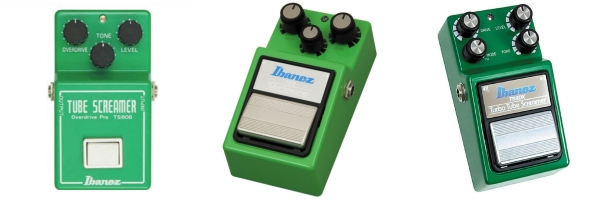
…then everyone copied it with their own little touches here and there:
- Behringer has a dirt cheap clone with the exact same circuit as the TS808, but in a cheap plastic housing.
- Also at the budget end of the spectrum is the Mooer Green Mile.
- JHS have artfully captured every variation of the originals from TS808 to TS10 plus a few others in their “Bonsai” pedal.
Nearly every pedal manufacturer out there has their own version of a Tube Screamer, so if you need to tighten your bottom end and push your mids, you have a lot of options open to you.
Blues Breaker
In 1966 John Mayall and the Blues Breakers recorded what became known as “the Beano Album”. Eric Clapton’s guitar sound on that album was obtained by way of a Marshall 1962 combo amp (JTM45) with everything cranked up to 11. That album made blues history, and so did Clapton’s tone. The amp went on to be nick-named the “Blues Breaker” as a result.
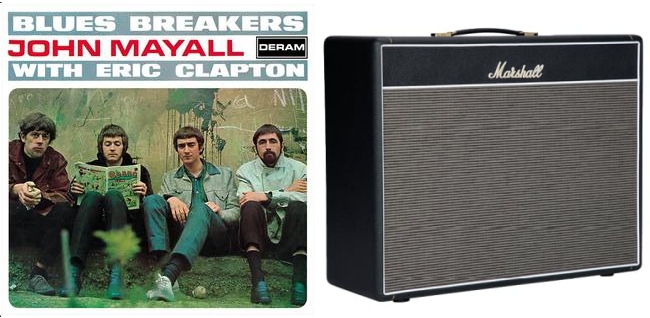
Skip forward to the early 90s and Marshall brings out an overdrive pedal based on that sound, this time officially called the Blues Breaker. It provided a mild, transparent overdrive, with a healthy amount of top end and just enough break-up to turn heads.
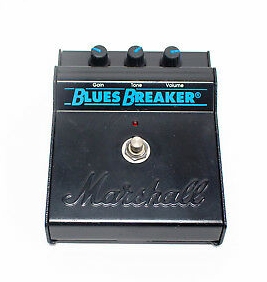
Two things drove the popularity of this pedal through the roof:
- It soon went out of production
- It was spotted on John Mayer’s pedal board around the time he started to become a household name
Since then, many pedal manufacturers have produced “Blues Breaker style” pedals. These pedals typically use the original as a starting point but then add their own subtle spin on it.
The first and most notorious was Analogue Man’s “King of Tone“. It brings a little bit more gain than the original and is essentially two of the same overdrive pedals in the one enclosure. This allows you to experiment with gain stacking and boosting one with the other. The single pedal version is called the Prince of Tone. If you don’t want to join the 2-3 year waiting list for a new King of Tone, and don’t want to pay collector’s prices for a second hand one, there’s always budget clones to consider.
Other Blues Breaker style pedals include the JHS Morning Glory, Pantheon by Wampler, and 1962 by Keeley.
Klon Centaur
Between 1990 and 1994 around 8000 hand built Klon Centaurs were sold. They were so highly sought after that since being discontinued, some have been selling for thousands of dollars.

The Klon is one of the most versatile drives around. It gives a slight upper mid boost, but for the most part just adds gain without touching your tone. At low gain settings it can act as a clean boost. Wind up the treble knob and we’re heading towards treble booster territory. Of course, wind the gain up and magic happens.
Klons differ from Tube Screamers in that they don’t roll off your bottom end, have higher headroom, and don’t compress as much. Their mid boost is a higher mid frequency than the one that Tube Screamers boost.
Another run of these pedals was released in 2014 under the name “KTR”. Printed on the front of these are the words “Kindly remember: the ridiculous hype that offends so many is not of my making”.
There are more clones of this pedal (or Klones as they’re affectionately known) than any other.
At the budget end of the spectrum we have:
Mosky Golden Horse
Caline Pegasus
Joyo Tauren
Electro-Harmonix Soul Food is at the pricier end of the budget list, but quite popular.
J Rocket Archer and Wampler Tumnus are among the most respected Klon style pedals. Wampler also has the Tumnus Deluxe which includes bass, mid, and treble controls.
The Ryra “Klone” is considered an almost immaculate part-for-part clone of the original.
So now if you hear someone talking about a Tube Screamer type, Blues Breaker type, or Klon type overdrive, you know what they’re talking about.
A few other worthy mentions:
The Boss BD-2 Blues Driver is a simple, decent sounding, full frequency overdrive that stacks well with others. It’s inexpensive and doesn’t attract a lot of hype, but is well respected and gets the job done.
The Fulltone OCD has become a bit of an institution. While most pedals will have a few useful sounds at different points along the sweep of their gain knob, the OCD sounds great across its whole range. It can go from a subtle dirty boost all the way through to aggressive distortion. Version 1 of these had a somewhat mid-pushed sound; the versions that came after it are a little mid-scooped.
Classic Distortion Pedals
The Boss DS-1 was one of the first widely adopted distortion pedals on the market. It’s pretty much remained a staple on pedal boards since then. Like the BD-2, it’s inexpensive, well regarded, and gets the job done. The top end is a bit harsh for some rigs, so you might need to turn the tone down to get a good sound out of it.
The Boss HM-2, dubbed “The Swedish Chainsaw”, was a key part of the guitar sound for bands like Entombed and At the Gates. The way it handles bottom end makes it perfect for low tunings. The odd thing about this pedal is that it has a massive dead spot on the gain knob between 3 and 8 o’clock. That didn’t seem to matter to those on the Swedish metal scene, as they only used one classic setting: every knob all the way up.
They’re out of production now* and fetch a somewhat elevated price second hand, as their appeal has never died off. Luckily there are a few decent modern adaptions available like the Walrus Audio “Red” and the Lone Wolf Audio “Left Hand Wrath”. Of course, where there’s an old Boss pedal there’s usually a cheap Behringer clone of it. Not to disappoint, Behringer has the HM300 with a more pronounced mid range.
*Update: Boss has just released a “Waza Craft” version of this pedal. Well worth checking out.
No discussion of distortion pedals would be complete without mentioning the fabled Metal Zone. The Boss MT-2 is probably the most mocked and maligned pedal ever to hit the market. It features
- Such a high noise floor it’s practically unusable
- A gain knob that goes from “gee that’s a lot of gain” at zero to “no one could possibly use this much gain” at around the half way point.
- A ridiculously broad range of overly sensitive EQ controls that make it incredibly easy to dial in a terrible tone, and a major project to find a good one (which the slightest bump will change back to a crap one)
- As an added bonus at no extra charge, the social stigma of being spotted with one on your pedal board.

Still, whether for irony, comedy, or perhaps *cough* different *cough* tastes, some folks still go after these. Apparently they don’t sound as bad if you put them through your effects loop. I’m not convinced.
In the confusing cross-over department:
There’s the Pro Co Rat, which sounds like a really aggressive distortion pedal, but is actually a fuzz circuit.
The Big Muff, which gets used interchangeably as a fuzz or distortion but is in fact neither. Accurately speaking, a Big Muff can only truly be classified as a Big Muff. Probably the most accurate description I’ve ever heard was “think of it as the noisiest compressor you’ve ever heard and go from there.”
Just like they’ve done with Tube Screamer sounds in the Bonsai, JHS have collected just about every variation on the Big Muff there ever was and crammed it into one pedal: The Muffuletta.
Fuzz
In the world of classic fuzz there is the Tone Bender and the Fuzz Face, with both spawning endless clones, tributes and adaptations. The Tone Bender has more pronounced mids and treble (great for cutting through the mix), while the Fuzz Face is known for its earth-shattering fat bottom end, amply demonstrated by Jimi Hendrix.
There are almost as many varieties of fuzz pedals on the market as there are overdrives. Combining fuzz with octave is a fairly classic one. For reference, check out the MXR Octave Fuzz.
JHS have released their version of re-issues of 4 classic fuzz pedals with their “Legends of Fuzz” line. Check out the Fuzz Face inspired Smiley, the Tone Bender inspired Bender, the Big Muff inspired Crimson, and the Univox Octave Fuzz inspired Supreme.
A quick word about transistors in fuzz pedals:
Fuzz circuits that utilise germanium transistors can sound like a million bucks, until you expose them to hot conditions which make them sound like rubbish. Silicon transistors are more consistent and aren’t affected by heat, but aren’t held in as high regard by tone purists. Honestly though, if you plug into a silicon Fuzz Face and don’t get a killer tone, I wouldn’t go blaming the silicon.
Enough for now!
That’s probably way too much information for a single blog post, but hopefully it’ll provide a good starting point for anyone trying to make sense of high gain pedals.
 Tone Quest