Intro to Pedals Part 2: Choosing Pedals

So you’ve decided that you want more from your guitar sound than what you get when you plug straight into your amp. It’s time to get a pedal or two, but which ones should you be checking out to begin with?

Multi Effects Units

A fairly common way to get an idea of what’s what, is to get hold of a multi effects unit which supposedly has everything in it. It’s significantly cheaper than buying one of every kind of pedal in existence, and side steps having to deal with mounting them to a board, hooking up lots of patch cables and worrying about power requirements.

If you have access to one of these, maybe on loan from someone else or acquired second hand for some freakishly negligible cost, it might be helpful to play with. You can scroll through all the effects while making an awful racket and taking note of which ones you find interesting.

I’ll stop short of recommending you spend significant money on one of these units, or spend a significant amount of time trying to sculpt a usable combination of sounds with one. I would strongly discourage buying a new one at full retail price.

What will inevitably happen is, over time you’ll discover at least 60% of the sounds in that unit are of no interest to you, and those that are happen to be important enough to you that you want a decent quality version of that effect in an individual pedal. I can’t think of a single guitar player who started out with a multi effects unit and went on to use it exclusively throughout their professional career.

Resale value on these things can be punishingly low, so selling it on once you’re done with it seems hardly worth it. This is not where you want to invest the bulk of your gear budget.

Having said all that, many professional musicians do occasionally gig with top quality modelling gear when they’re travelling light or they don’t want to take their expensive vintage equipment to a particular gig. Worthy of note among these are the Line 6 Helix range, and Neural DSP Quad Cortex.

Those aren’t cheap though, and for the same or less money you could buy one of the actual amps or some of the effects that they’re trying to sound like. Why not have the real thing? When you buy modelling equipment you’re paying for access to a vast range of sounds, most of which you’ll never use.

This brings us to the most important question you need to keep in mind when shopping for pedals: “What are the effects I need in order to generate the guitar sounds I want to play?”

Knowing What to Use

Put together a playlist of the kind of music that you’re likely to play on guitar. Listen to what effects the guitarists in those recordings are using. This will be your starting point. I’m going to make a few suggestions here but you don’t necessarily need these pedals to play that music.

Get a Tuner

OK forget what I just said about not needing the pedals I suggest here. Every guitarist needs a tuner, and that means you, too. Pedal tuners are about the most practical on the market. When you consider the alternatives are either rack mounted, headstock/clip on tuners, or a pitch pipe, this just makes sense.

Important things to look for in a tuner are:

  • Accuracy
  • Tracking speed (when you pluck a note, you don’t want to have to wait for the tuner to “find” it)
  • Visibility in different lighting situations (consider dark/low light in a club versus bright sunlight at an outdoor gig)

The TC Electronic Polytune is hugely popular, and for what it’s worth I’m a big fan of the Korg Pitchblack Custom. While the visibility isn’t quite as impressive as the Custom version, the standard Korg Pitchblack performs much the same and costs a fair bit less.

You don’t have to spend a fortune on a multitude of features here, but you only want to have to make this purchase once and be done with it. This isn’t a fun or exciting pedal, and if you cheap out on something that’s a massive compromise, you might find yourself going through the banality of shopping for another one in the not-too-distant future. There’s no such thing as a “beginners tuner” so you might as well make the investment in a proper one straight away.

Your Average Rock Band

Straight away you’re going to need some sort of overdrive, and it’s quite likely you’ll only need one. If you’re going to play the odd lead break, you may want to also invest in a lead boost. That would sort most rock guitarists out, and this is reflected in the amount of “dual overdrives” on the market (essentially an overdrive with a second switch to engage a boost).

It’s not all that uncommon to want to make use of several different gain stages:

  • a light, just-past-edge-of-break-up overdrive
  • a more aggressive, higher gain overdrive
  • a lead boost

Stacking all of those into each other could also approximate a decent full-fat distortion in a pinch.

Your Average Covers Band

Covers bands play a bit of everything, so surely you’re going to have to get the lot, right? Not necessarily.
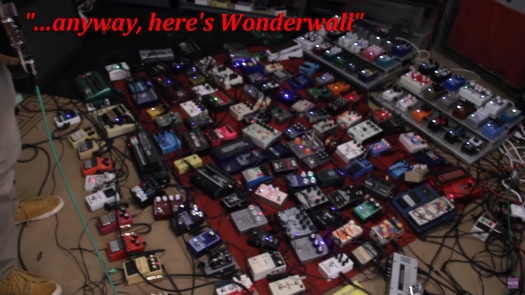
Assuming your amp already has reverb, you’ll be surprised just how far you can get with a range of different gain stages (see above) and a delay pedal.

Depending on the material you’ll be covering, you may want to get some sort of modulation. Most commonly this will be chorus and tremolo, but occasionally you may need a flanger/phaser/vibrato etc.

If you’re doing 60s rock covers, you’ll want to get a wah pedal, a fuzz, and maybe a uni-vibe.

The Heavy Stuff

If you’re playing heavy music, some kind of distortion is a must. A lot of metal guitarists will achieve this via an amp with a high gain channel. If you take this route, it’s still worth looking at some kind of lead boost. Consider how loud it is when the rest of the band is pummelling out a down-tuned heavy riff at full volume. Your tiny little single note lines don’t stand a chance of being heard in that mix without some kind of assistance.

Stepping on a Tube Screamer or some kind of Tube Screamer derivative at this point would help a great deal. It would tighten up your bottom end, increase your mids, and in doing so raise your most audible frequencies so the audience can hear you. If you crank the level knob you’ll also enjoy a cheeky increase in overall volume. Most lead boosts will operate like this: they’ll likely lift your upper mids and increase your volume.

If you don’t have a high gain amp, you’re going to need a distortion pedal. There are so many types of distortion pedal on the market I could dedicate an entire series of posts just on this topic. I’ll try to give you a quick over view to get you started on your search.

The good old fashioned Boss DS-1 was a go-to pedal in the 80s but is a bit too shrill and spikey sounding for some rigs. Dialling the tone knob all the way back on one of these might get you the exact sound you’re after without spending a whole lot. A Rat might be worth a look if you want something old school but a bit darker and thicker sounding. They’re kind of a cross between a DS-1 and a Fuzz Face.

If sludgy, doomy, fuzz-meets-distortion is what you’re after, check out the world of Big Muffs. There’s a lot of variation between the different Muffs available, so do your research and try a few out.

If you’re chasing a more modern, djenty sound, there’s quite a lot of options. Check out Deizel pedals for starters. This company is renowned for making epic sounding high gain amps, and they’ve done a decent job of capturing that distortion sound in their pedals.

James Brown (no, not that one, the guy responsible for the design of the Peavey 5150) now has a pedal company by the name of Amptweaker. His distortion pedals are next-level awesome. The MXR 5150 overdrive pedal is geared towards the distortion sound of that amp, and like the Amptweaker stuff, comes with a built in noise gate.

Music hasn’t sounded quite the same since either of these two guys came along.

If you’re looking to spend a little less, there’s the Hotone Djent. It looks like a toy but sounds like the business.

Conclusion

These are all just broad suggestions on where to start if you’re not sure. Whatever you run with for your first pedals, get cheap ones to start with.

Yes, I would discourage spending good money on a multi effects unit to try it all out, on the basis that you’ll probably move on from it and not get your money back. I will however encourage you to take a similar approach with a handful of cheap pedals instead. You might experience a few less effects, but you lose less money and focus on the more relevant pedals to your playing style.

While you figure out what flavour of overdrive or fuzz or distortion etc you’re into, you’re going to swap out and trade your way through a whole bunch of pedals. Better to do that with cheap ones first of all. Even if you start with expensive pedals, you can still be almost certain you’ll end up moving them on at a loss once you refine your tonal tastes.

Here’s how I’d recommend the commencement of your pedal journey:

  • Listen closely to recordings of the genre of music you’d like to play
  • Take note of the effects involved
  • Buy some cheap versions of those effects
  • Once you know what sort of sounds you like, have a look at which pedals on the market do a top notch version of that sound within your budget

Just a word of warning: once you start experimenting with pedals, it’s a slippery slope towards full blown pedal addiction. You’ll quickly find all sorts of pathetic excuses to spend more than you should on just one more pedal. Always keep in mind what you’re trying to achieve with your tone before you browse for pedals, and likewise keep a close eye on your budget. You have been warned.

Once you’ve got a handful of pedals you’ll be wanting to hook them all up in a practical and portable manner. In my next post I’ll be exploring all the non-pedal parts of your floor based gear: pedal boards, patch leads, power requirements, and other stuff you could potentially lose a heap of money on through buying the wrong gear or cutting costs in the wrong area. This post will cover all the hidden expenses we forget about while lusting after the gear that makes cool sounds.

Know Your Dirt

In the world of high gain guitar sounds we have boost, overdrive, distortion, and fuzz.

Boost can add a little gain and EQ shaping with a bit of a kick in volume.

Overdrive was born from the sound of an amp literally being driven too hard. This term could cover anything from an almost clean edge-of-break-up sound, to a cranked Marshall sound.

Distortion is a bit like overdrive on steroids, with more aggressive clipping and more compression.

Fuzz is a different thing altogether. This is where we encounter some of the harshest “square wave” clipping available.

Then there’s the grey area where these overlap. When these sounds were initially discovered there were no clear distinctions between them. Some boosts creep into overdrive territory. Some overdrives could just as easily be described as distortion, or dialed back and used as a boost. There are at least a handful of pedals around where internet debates continue to rage over whether they’re distortion or fuzz.


Overdrive Pedal Types

The number of overdrive pedals on the market right now is staggering. If you took one of each model and piled them on top of each other, you could use it as a bridge to Mars and save Elon Musk a lot of bother.

Mercifully though, many of them fall into categories which help when you’re comparing them to decide what you’re after. Let’s take a look at a few.


Tube Screamers
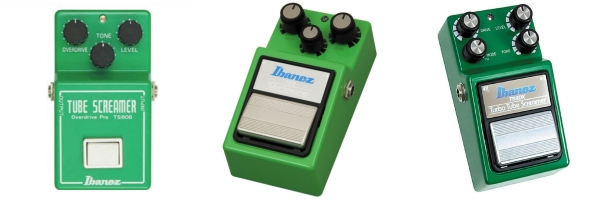
Ibanez brought out the tube screamer as an overdrive pedal designed not so much to bring all the crunch on its own, but to push the front end of a tube amp into its own overdrive. It dumps your bottom end and cranks your mid range right up, with some mild clipping for good measure.

Some folks use these after their regular overdrive or distortion as a lead boost. Others use it before their distortion to clean up an otherwise boomy bottom end. You’ll often see these in front of a Peavey 5150/6505 or Mesa Boogie Dual Rectifier in metal bands for this reason.

  • First there was the TS808 described above (and the small version, the Tube Screamer Mini).
  • Then the TS9, a bit brighter and harsher sounding, and arguably more aggressive.
  • The TS9DX which was a TS9 with more settings, including one which leaves the bottom end in tact.
  • The TS10, which by all accounts seems to be a cheaply made TS9, maybe with a smidge more gain on offer.


…then everyone copied it with their own little touches here and there:

  • Behringer has a dirt cheap clone with the exact same circuit as the TS808, but in a cheap plastic housing.
  • Also at the budget end of the spectrum is the Mooer Green Mile.
  • JHS have artfully captured every variation of the originals from TS808 to TS10 plus a few others in their “Bonsai” pedal.

Nearly every pedal manufacturer out there has their own version of a Tube Screamer, so if you need to tighten your bottom end and push your mids, you have a lot of options open to you.


Blues Breaker
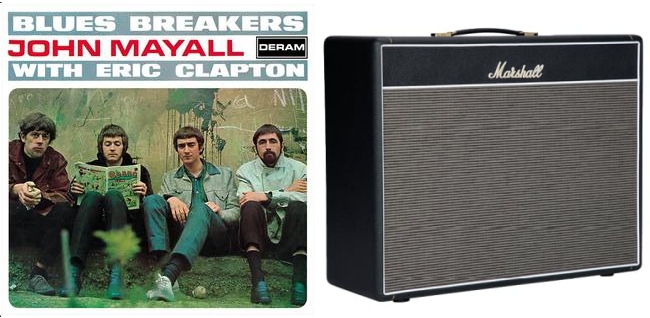
In 1966 John Mayall and the Blues Breakers recorded what became known as “the Beano Album”. Eric Clapton’s guitar sound on that album was obtained by way of a Marshall 1962 combo amp (JTM45) with everything cranked up to 11. That album made blues history, and so did Clapton’s tone. The amp went on to be nick-named the “Blues Breaker” as a result.

A pivotal moment in blues guitar history

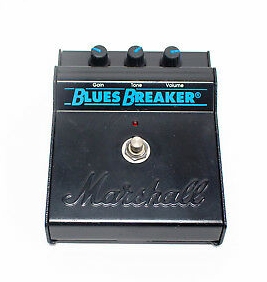
Skip forward to the early 90s and Marshall brings out an overdrive pedal based on that sound, this time officially called the Blues Breaker. It provided a mild, transparent overdrive, with a healthy amount of top end and just enough break-up to turn heads.

Two things drove the popularity of this pedal through the roof:

  1. It soon went out of production
  2. It was spotted on John Mayer’s pedal board around the time he started to become a household name

Since then, many pedal manufacturers have produced “Blues Breaker style” pedals. These pedals typically use the original as a starting point but then add their own subtle spin on it.

The first and most notorious was Analogue Man’s “King of Tone“. It brings a little bit more gain than the original and is essentially two of the same overdrive pedals in the one enclosure. This allows you to experiment with gain stacking and boosting one with the other. The single pedal version is called the Prince of Tone. If you don’t want to join the 2-3 year waiting list for a new King of Tone, and don’t want to pay collector’s prices for a second hand one, there’s always budget clones to consider.

Other Blues Breaker style pedals include the JHS Morning Glory, Pantheon by Wampler, and 1962 by Keeley.


Klon Centaur
Between 1990 and 1994 around 8000 hand built Klon Centaurs were sold. They were so highly sought after that since being discontinued, some have been selling for thousands of dollars.

The Klon is one of the most versatile drives around. It gives a slight upper mid boost, but for the most part just adds gain without touching your tone. At low gain settings it can act as a clean boost. Wind up the treble knob and we’re heading towards treble booster territory. Of course, wind the gain up and magic happens.

Klons differ from Tube Screamers in that they don’t roll off your bottom end, have higher headroom, and don’t compress as much. Their mid boost is a higher mid frequency than the one that Tube Screamers boost.

Another run of these pedals was released in 2014 under the name “KTR”. Printed on the front of these are the words “Kindly remember: the ridiculous hype that offends so many is not of my making”.

There are more clones of this pedal (or Klones as they’re affectionately known) than any other.

At the budget end of the spectrum we have:
Mosky Golden Horse
Caline Pegasus
Joyo Tauren

Electro-Harmonix Soul Food is at the pricier end of the budget list, but quite popular.

J Rocket Archer and Wampler Tumnus are among the most respected Klon style pedals. Wampler also has the Tumnus Deluxe which includes bass, mid, and treble controls.

The Ryra “Klone” is considered an almost immaculate part-for-part clone of the original.


So now if you hear someone talking about a Tube Screamer type, Blues Breaker type, or Klon type overdrive, you know what they’re talking about.


A few other worthy mentions:

The Boss BD-2 Blues Driver is a simple, decent sounding, full frequency overdrive that stacks well with others. It’s inexpensive and doesn’t attract a lot of hype, but is well respected and gets the job done.

The Fulltone OCD has become a bit of an institution. While most pedals will have a few useful sounds at different points along the sweep of their gain knob, the OCD sounds great across its whole range. It can go from a subtle dirty boost all the way through to aggressive distortion. Version 1 of these had a somewhat mid-pushed sound; the versions that came after it are a little mid-scooped.


Classic Distortion Pedals

The Boss DS-1 was one of the first widely adopted distortion pedals on the market. It’s pretty much remained a staple on pedal boards since then. Like the BD-2, it’s inexpensive, well regarded, and gets the job done. The top end is a bit harsh for some rigs, so you might need to turn the tone down to get a good sound out of it.

The Boss HM-2, dubbed “The Swedish Chainsaw”, was a key part of the guitar sound for bands like Entombed and At the Gates. The way it handles bottom end makes it perfect for low tunings. The odd thing about this pedal is that it has a massive dead spot on the gain knob between 3 and 8 o’clock. That didn’t seem to matter to those on the Swedish metal scene, as they only used one classic setting: every knob all the way up.

They’re out of production now* and fetch a somewhat elevated price second hand, as their appeal has never died off. Luckily there are a few decent modern adaptions available like the Walrus Audio “Red” and the Lone Wolf Audio “Left Hand Wrath”. Of course, where there’s an old Boss pedal there’s usually a cheap Behringer clone of it. Not to disappoint, Behringer has the HM300 with a more pronounced mid range.

*Update: Boss has just released a “Waza Craft” version of this pedal. Well worth checking out.

No discussion of distortion pedals would be complete without mentioning the fabled Metal Zone. The Boss MT-2 is probably the most mocked and maligned pedal ever to hit the market. It features

  1. Such a high noise floor it’s practically unusable
  2. A gain knob that goes from “gee that’s a lot of gain” at zero to “no one could possibly use this much gain” at around the half way point.
  3. A ridiculously broad range of overly sensitive EQ controls that make it incredibly easy to dial in a terrible tone, and a major project to find a good one (which the slightest bump will change back to a crap one)
  4. As an added bonus at no extra charge, the social stigma of being spotted with one on your pedal board.
Visual representation of the sound of the Boss MT-2

Still, whether for irony, comedy, or perhaps *cough* different *cough* tastes, some folks still go after these. Apparently they don’t sound as bad if you put them through your effects loop. I’m not convinced.

In the confusing cross-over department:
There’s the Pro Co Rat, which sounds like a really aggressive distortion pedal, but is actually a fuzz circuit.

The Big Muff, which gets used interchangeably as a fuzz or distortion but is in fact neither. Accurately speaking, a Big Muff can only truly be classified as a Big Muff. Probably the most accurate description I’ve ever heard was “think of it as the noisiest compressor you’ve ever heard and go from there.”

Just like they’ve done with Tube Screamer sounds in the Bonsai, JHS have collected just about every variation on the Big Muff there ever was and crammed it into one pedal: The Muffuletta.

Fuzz

In the world of classic fuzz there is the Tone Bender and the Fuzz Face, with both spawning endless clones, tributes and adaptations. The Tone Bender has more pronounced mids and treble (great for cutting through the mix), while the Fuzz Face is known for its earth-shattering fat bottom end, amply demonstrated by Jimi Hendrix.

There are almost as many varieties of fuzz pedals on the market as there are overdrives. Combining fuzz with octave is a fairly classic one. For reference, check out the MXR Octave Fuzz.

JHS have released their version of re-issues of 4 classic fuzz pedals with their “Legends of Fuzz” line. Check out the Fuzz Face inspired Smiley, the Tone Bender inspired Bender, the Big Muff inspired Crimson, and the Univox Octave Fuzz inspired Supreme.

A quick word about transistors in fuzz pedals:
Fuzz circuits that utilise germanium transistors can sound like a million bucks, until you expose them to hot conditions which make them sound like rubbish. Silicon transistors are more consistent and aren’t affected by heat, but aren’t held in as high regard by tone purists. Honestly though, if you plug into a silicon Fuzz Face and don’t get a killer tone, I wouldn’t go blaming the silicon.

Enough for now!

That’s probably way too much information for a single blog post, but hopefully it’ll provide a good starting point for anyone trying to make sense of high gain pedals.