Beginners Guide to Using a Guitar Amp

Remember at school when you were shown how the various knobs and features of a guitar amp work? Me neither. You don’t want to be figuring this out on the fly when you turn up to your first jam, or when you’re trying out an amp in front of a pushy salesman. With that in mind, let’s have a bit of a tour around your average amp.

The Big Picture

Your guitar sound enters the amp at the input, gets shaped in the pre amp, and travels through any effects you may have in the effects loop. The power amp then takes that sound, makes it bigger and sends it to the speaker.

Sounds simple enough, but let’s take a look at how you can tweak that sound in each section of the amp.

Power on & Standby

It’s probably good practice to roll your volume down before turning your amp off, and make sure it’s still down before you turn it back on. I’m no amp tech, but the pop you get when you throw the power switch with the volume still up does not sound healthy for the amp. If nothing else, it’s a courtesy for everyone else in the room. Let’s face it, on a decent sized valve amp, that “pop” is more of a heart stopping “boom”.

As for standby, it’s largely debated as to whether there’s any point in using this feature. Most folks who know a thing or two about amps will tell you that this switch continues to be installed on amps as little more than a superstitious tradition. Having said that, if your manual tells you to leave your amp on stand by for a bit before using it, I don’t want to be the one to void your warranty.

Pre Amp

Inputs

If your amp has multiple inputs, you might be wondering which one you should be using, and why you need choices when it comes to simply plugging in.

On Fender amps with two inputs, one of these will be for pickups with a low output and the other for higher output pickups like humbuckers. When you see four inputs on a Marshall amp, these will be a high and low sensitivity input for each of its two channels.

Bright Switch

Some guitars’ pickups are darker sounding than others. To accommodate for this, some amps will have a bright switch near the input socket which will kick in a little more treble.

Gain

The gain knob controls the signal strength coming into the amp. While originally it may have been intended as another consideration to adjust for pickups with different output levels, the far more popular use of this knob is to turn it up until the signal clips with overdrive.

EQ

The eq section lets you adjust the tonal characteristics of your sound by tweaking certain frequencies or certain ranges of frequencies.

If you want to sound impressive playing on your own, use lots of bottom end while dropping your mid-range for clarity. If you want to be heard at all in a band setting, you’ll want to do the exact opposite. Check out this article about working with overdrive to learn more about setting eq and gain for audibility in a band setting.

Tweaking your low, middle, and high frequencies is a straight forward affair while you have three knobs which correspond with them. What happens when you only have low and high knobs?

It’s simple enough once you get used to an eq like this, but it can be a real hurdle for newcomers. Both of these knobs affect themselves and the mid-range at the same time. Here are a few examples of how they do this:

  • Low and high at halfway: mids are also at half way
  • Low and high cranked: mids are scooped (turned down)
  • Low and high turned down: mids are turned up

Multi-Channel Amps

On amps with more than one channel it’s not uncommon to find a row of gain and EQ knobs for each channel. It’s often the case that each separate channel is a separate pre amp circuit; although in some amps the second channel is actually just a higher gain setting with maybe a bit more treble. If that’s the case you probably won’t have much to tweak the second channel with.
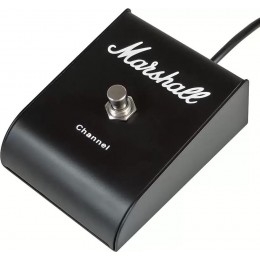
There’s usually a footswitch you can connect to select which channel you want, but you might also find a switch on the amp that does the same thing.

Effects Loop

If your amp has an effects loop it’ll typically be on the back panel. To learn more about why you might want to use an effects loop, check out this article on pedal signal chain. Using the loop isn’t all that complicated. You plug a lead in from the “send” on your amp into the input of your pedal. The lead from the output of your pedal goes into the “return” of the loop on your amp.
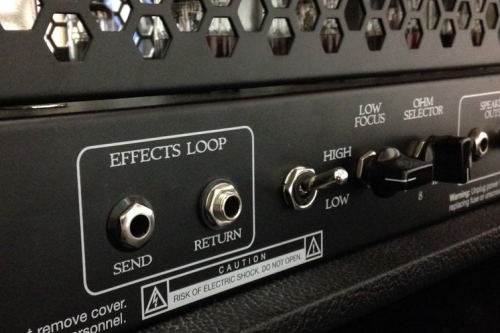
Power amp

Master Volume

This one is pretty straight forward: it dictates how loud the power amp makes the signal before handing it to the speaker. I should clarify what’s happening here though.

Your power amp is actually always fully cranked, amplifying anything it’s given as much as it can. Much like how the gain knob controls how much signal comes into the pre amp, the master volume knob controls how much signal gets passed from the pre amp onto the power amp.

Presence

When you turn down the Master Volume, you might lose some of the high end from your tone. The Presence control is like a treble control for your power amp, allowing you to recover any lost top end once you turn the volume down.

Speaker Out

This is where you plug a lead from your amp to your speaker. It’s critical you don’t get this bit wrong. First of all, despite looking pretty much the same, instrument cables and speaker cables are different. Even though they both fit into these sockets, it’s important you only use speaker cables for this job, as using an instrument cable here could do damage. Plugging a speaker cable into your guitar would make it vulnerable to interference and noise.

The other thing to look out for here is making sure the amp impedance and speaker impedance match. I could (and probably should) write a whole post about speaker impedances and how to calculate the ohms for different combinations of speakers. For now though, just know that this requires caution. Don’t feel silly consulting your amp’s manual or asking for help from someone who knows about it.

One more caution about this part of the amp: if your amp is a valve amp, never turn it on without a speaker connected.

Dialling it all in

Quiet practice at home

Get the volume to a level you can work with, and then adjust the gain and eq to compensate for the overall reduction in sound. This is where the presence knob will come in handy.

With the volume knob on your guitar set to about half way, turn the gain on your amp up until it starts to break up, and then back it off a tiny bit. This will give you as much sustain and harmonic content as you can get while still having a clean tone. From there you can either use pedals for your drive sounds, use another channel in your amp, or simply roll your guitar’s volume up and hit the strings harder to push the amp into overdrive.

In a band setting

While the band is making a lot of noise, set your volume so you can hear yourself clearly. You won’t win a prize for being the loudest person in the room, and it’s pointless not having it loud enough for you and the rest of the band to hear.

Now adjust your gain as outlined above and set your eq to taste. It’s important to do all this while the band is playing at performance volume, as your audible frequencies are different in a band mix.

If you have the luxury of being able to play fairly loud, try this: Once you’ve got your clean sound dialled in with the pre amp gain at edge-of-break-up, turn the master volume up until the power amp starts to overdrive, then back it off just a little. Now when you push the amp into overdrive you’ll have both the pre amp and power amp breaking up. This is what people refer to as natural amp overdrive. If you only use the pre amp on its own for drive sounds, you’re missing out.

Classic Amp Sounds

While describing the tonal characteristics of an amp or pedal, people will often reference classic amp sounds. No doubt you’ve heard terms like “Fender cleans”, or “cranked Marshall” to describe how something sounds.

That’s not very helpful if you have no idea what they’re referring to. Hopefully we can fix that by having a look at the sort of sounds different classic amps are known for and why they sound the way they do.

Fender

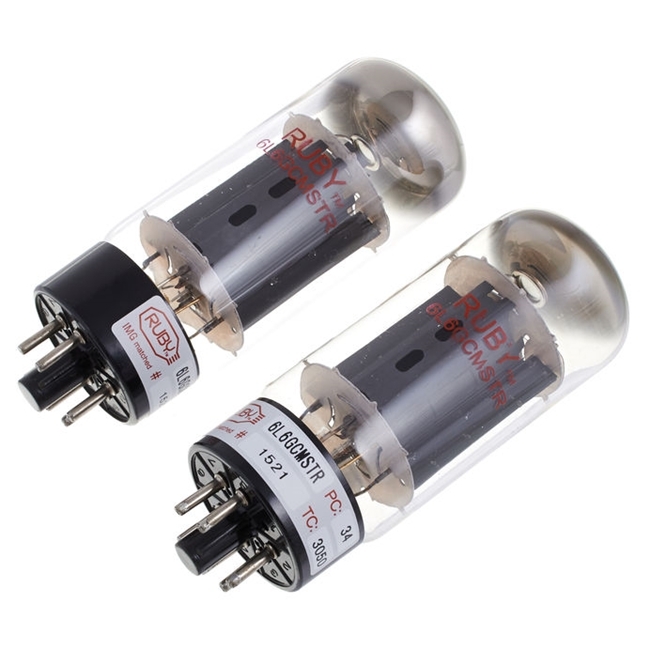
In the early days overdrive was something to be avoided, so Fender aimed to make an amp that could get loud without breaking up. In the power amp they typically have a pair of 6L6 tubes, providing bucket loads of clean headroom.

6L6 Power Tubes

At low to mid volume levels they tend to have a scooped mid range. This emphasises the high and low end, making those clean tones sound big and smooth.

As you turn them up, more mid range starts to roll in. If you crank them all the way up, magic happens: When an amp that was designed not to break up is pushed so hard that it does, you get a glorious, massive sounding overdrive.

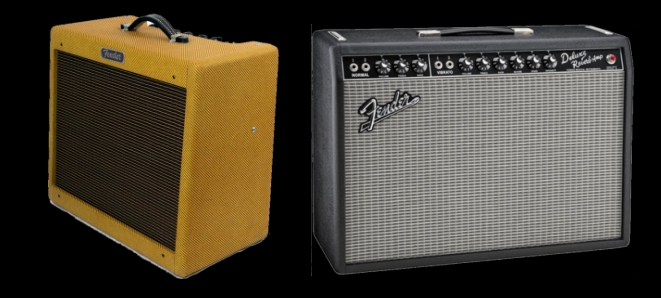
Tweed vs Black Panel

The sound outlined above probably best describes what is known as the black panel tone, or “blackface” to those for whom that phrase doesn’t primarily conjure up mental images of black and white minstrels. I’m not being “woke”, do an image search on “blackface” and let me know in the comments how many Fender amps you see.

We’re referring to the black control panel on the more modern Fender amps. Prior to this, Fender had their tweed range. These amps were far less powerful, and when turned up to stage levels would often start to overdrive. The tweed sound is associated with early gritty blues guitar sounds.

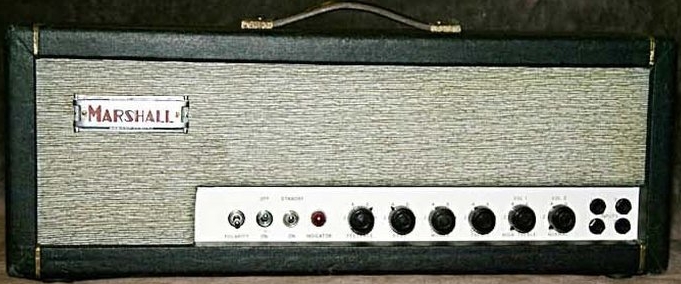
Marshall

Marshall’s first amps were an attempt to copy Fender’s offerings. Being made on a different continent meant that different components had to be utilised, and to accommodate those different parts, design changes were made.

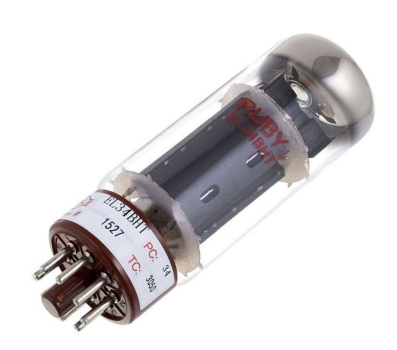
Using EL34 tubes in the power amp meant they could be pushed into overdrive sooner. They also typically had much more mid range than a Fender.

EL34 Power Tube

They became notorious for their overdrive and mid-focussed tone, which made them an obvious choice for early rock guitar pioneers.

Hiwatt

When most people think of Hiwatt amplifiers, they think of ridiculous volume levels. These things are loud. They have the endless clean headroom of a Fender with an EQ curve somewhere closer to a Marshall.

Vox

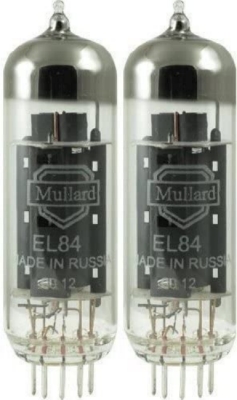
These amps are best known for their top end response. You can hear this in the Beatles’ chimey, jangley clean tones, and Brian May’s treble focussed overdrive sounds in Queen. In the power amp they utilise EL84 tubes, which are a bit like EL34s but with less headroom. This means they’re often quieter and quicker to break up than a Marshall.

Vox AC30

EL84 Power Tubes

Orange

Think of Orange amplifiers as being like a Marshall only more so. They have more aggressive mid range and more gain on tap, allowing for heavy overdrive from the preamp section without having to crank the power amp into break up.

Mesa Boogie

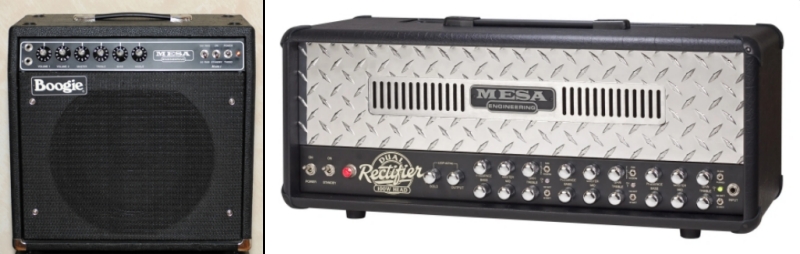
The first ever Mesa amps were actually modded and re-badged Fender Princetons. They have a tonal response somewhere in the ball park of a Fender, but usually with many more features. The most common of those features would be a high gain channel.

The distortion sounds from the Dual Rectifier were pretty much the heavy metal standard from the early 90s to the late 00s.

“American Sound” vs “British Sound”

The big names on the American market were Fender and Mesa. Their sounds are typically high headroom and low mid range, with super sweet clean tones. Most people think of Vox and Marshall when they refer to the “British” sound, implying a more mid range to high end focus and earlier power amp break up.

The Brown Sound

This has nothing to do with the “brown note”, or the extreme low frequencies rumoured to cause fecal incontinence. It does however refer to a high gain guitar tone that has the potential to make rock guitarists shit themselves with excitement when they hear it.

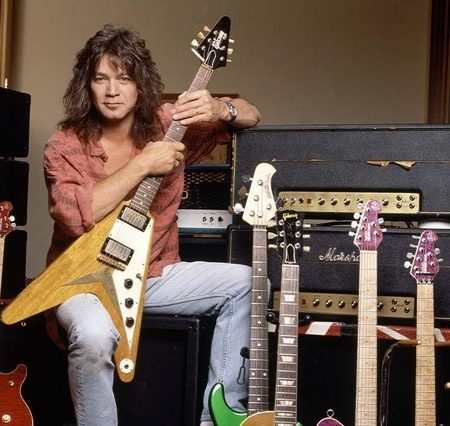
Edward Van Halen used this term to describe his tone. In the early days, that tone was achieved by way of a Marshall Super Lead with everything turned all the way up. Where most rock guitarists were aiming to cut through the mix with plenty of mids and treble but little bottom end, Van Halen wanted a warmer sound that retained bottom end. I should note that over the years he used less and less mid range in his tone.

In general though, if someone refers to the “Brown Sound”, they’re probably talking about a high gain sound with a balanced EQ and the volume as loud as you’re prepared to push it.

Disclaimer

What I’ve described above are all gross generalisations. In this context though (making sense of buzz words like “British tone” or “Fender cleans”) generalisations can be helpful. It’s important to note that you can get two amps of the same model and have them sound different to each other. My goal here was not so much to help you choose which amp to buy, but to help you decipher marketing hype with music gear in general.

Intro to Pedals Part 5: Signal Chain

Effective pedal order is a subject that used to be treated as a great mystery, as though the correct signal path for each guitarist can only be known by them exclusively, and even then only after some kind of mystical revelation.

That’s absolute rubbish of course. People have been experimenting with their signal chains for decades now, common results have been documented, and a rough idea of best practice has been arrived at. In this post we’ll go over what that “best practice” looks like, why it works the way it does, and help you decide if, when, and how to “break the rules” so to speak.

Let’s get into it.

Standard Practice

Pitch

First of all, anything that needs to track the pitch of your guitar should get the cleanest, most unadulterated signal that it can if you want it to have a sporting chance of doing its job properly. By this I’m referring to your tuner, pitch shifters like the Digitech Drop and Whammy, and perhaps even octave pedals.


Gain

After that, it’s a good idea to have your drive section towards the start of the chain. This includes fuzz, overdrive, boost, and distortion.

Drive pedals typically define your EQ and gain level, which form the core, fundamental part of your tone. From that perspective it makes sense to establish this first before letting other pedals do freaky things with your core tone later in the chain.

Putting drive pedals after other pedals can radically change the way they sound. There are definitely situations where that can sound cool, but we’ll cover those later. For now let’s keep things fairly simple and vanilla.


Modulation

Next in the chain would be modulation pedals. This is the wobbly stuff:

  • Vibrato (modulates your pitch up and down rhythmically)
  • Chorus (splits your signal in two and applies vibrato to one of them)
  • Phaser (splits your signal in two and moves them in and out of phase with each other)
  • Flanger (splits your signal in two and adds a subtle delay to one of them, creating a swooshing effect)
  • Tremolo (modulates your volume up and down, creating a shimmery or choppy sound).

Modulation pedals add character and create a sense of movement to the core tone you established in your drive section.


Time

After modulation we deal with time and space via delay and reverb. The idea of these is to take your whole signal and make it sound like it’s echoing back from or reverberating off the walls of a large space. For that reason you might want to send all of your effects into these.


The Fight for Last Place

Given that tremolo works by rhythmically dropping your volume, it’s possible that reverb tails or delay repeats which fall in that otherwise silent space might counteract the feel of it. For this reason, some people like to put tremolo at the end of their chain.

Then again, putting tremolo after delay creates the possibility of that silence coinciding with delay repeats, making it feel as though the delay isn’t turned on at all. The other possibility is your dry signal being silenced by the tremolo and only allowing the repeats through. The most likely scenario would be a mess of both. Best to experiment if you want to use delay and tremolo at the same time.


The Fight for First Place

For all their tough-guy image, some fuzz pedals can be total princesses about their input impedance. This means if they’re not the very first pedal in your chain they can behave like a spoilt brat.

Wah pedals typically go before your drive section to function properly, so if you have temperamental fuzz, you might have some experimenting and prioritising ahead of you. You’re in for a real headache if you have a fussy fuzz, a wah pedal, and a pitch-based effect that you intend on using at the same time.

The big picture looks something like this:
Pitch – Gain – Modulation – Time

I’ve seen some people on guitar forums post the chart below from Roland, stating that it’s all you need to know on the subject of signal chain. As we’ve just seen though, it’s not that simple.

There are a few issues that make it not terribly helpful for new guitarists trying to get their heads around signal chain issues:

  • It makes no attempt to include a fuzz
  • It does not tackle the tremolo dilemma
  • It includes a Metal Zone. Honestly, what kind of message are they trying to send to new guitarists? What’s next? Handing out crack at a kindergarten?


Gain Stacking

Hopefully you’ve now got a decent idea of standard practice for the order of most pedal types. Within your drive section though, you might have a bunch of different types of gain pedals. Let’s have a look at how you might want to order them.

Just in case your fuzz pedal is the sort of entitled infant that will throw a hissy fit if it’s not first in line, we’re going to give it what it wants: Fuzz first.

Of course you love your Fuzz. It’s ok to feel sick of its bullshit from time to time.

From there though, you need to consider what you want your drive pedals to do.

If you want one pedal to provide a volume lift for another, you would place the heavier gain pedal first and the lighter gain pedal second. Order your drives from heaviest to lightest to get a big, high headroom drive sound.

If you want one pedal to add more distortion to another, you would place the lighter gain pedal before the heavier one. Order your drives from lightest to heaviest to end up with a chain of cascading nastiness.


Breaking the Rules

The number one piece of advice handed out to people who ask about pedal order is to “try it out for yourself”. Fortunately for you I’m not a complete asshole, and I acknowledge what a pain it can be to completely re-route your pedal board just to see what will happen. In this next part I’m going to try to explain the most likely outcome should you stray from standard practice.

That’s not to say you shouldn’t experiment. No one’s going to call the cops if you put your reverb first in your chain and your fuzz pedal last. There’s a pretty good chance you won’t enjoy the outcome, but you are of course free to do what you want. Experimenting and listening will no doubt give you a much better perspective than reading about it in a blog post.


Gain after Modulation

Placing drive after another kind of pedal will take its signal and compress it, smoothing it out and making it more consistent. With modulation, that kind of defeats the purpose.

Then again, maybe you have a modulation pedal that’s a little bit drastic for your tastes. Putting a subtle overdrive after it could tame it nicely. This would be a sensible reason to put drive after modulation.

Having said that, putting a killer high-gain metal distortion after modulation probably won’t be as kick-ass as you’re hoping. The distortion would sound more impressive with a clean signal going into it, and would only work to minimise and muddy-up the modulation.


Gain after Delay

Delay repeats typically decay or get quieter as they go on. If you put a drive pedal after it though, the compression will interfere with that decay. Repeats will continue for longer and potentially crash into each other. It’s a big, chaotic noise that might be fun to play with, but not what most folks have in mind when they reach for a delay pedal.

A slap back delay (one repeat with an extremely short delay time) can work either side of a drive without issue.


Gain after Reverb

Similar to the issue with repeat decay in delay pedals, putting a drive pedal after reverb will make the reverb tails carry on longer and create a big, chaotic noise. Again, fun to play with, but practically unusable unless you’re in a shoe-gazer band or avant garde noise act.


Using the Effects Loop

If your amp is already breaking up without the use of drive pedals, then your amp is acting like an overdrive pedal at the end of your chain. If you’ve taken anything from this article so far you’ll know this could be problematic.

While there’s probably a whole article I could write about how amps work, for now let’s just look at the two main parts: the pre amp and the power amp.

The pre amp sets the gain and EQ of your signal before handing it over to the power amp, which makes the whole thing louder. It’s the pre amp which is likely causing your amp to overdrive.

An effects loop lets you plug a few pedals between your pre amp and power amp. If you use your pre amp for your drive sounds, you can still maintain your signal chain by putting your modulation, delay, and reverb pedals in the loop.


What about a Phrase Looper?

There’s often confusion about where to put a loop pedal. These typically go at the end of your chain before your amp so they can catch everything, but again, you don’t have to do what everyone else does. Just remember that it will record anything you put in front of it, and its playback will be affected by anything you put after it.


Where Do I Put My EQ Pedal?

Put your EQ pedal wherever you feel the EQ correction needs to be made. If you’re trying to counteract a tonal quality of a specific pedal (like put some mids back in if you’re using a Muff, or bottom end if you’re using a Tube Screamer) put the EQ immediately after the pedal in question.

EQs can be fun to play with in your drive section. Just turning the level up can make it work like a boost. Cranking a specific frequency before sending your signal into a drive pedal will make that frequency overdrive more.


That’s All For Now

Hopefully that should cover most of the common questions that pop up around all things signal chain.

If I could impart any advice on the subject it would be to have a clear idea in mind about what you want to achieve before you start plugging things in, to save a lot of mucking around. Also, having said that, feel free to experiment and let your ears guide you.

Oh, and if you see this guy lurking around outside your school trying to sell Metal Zones: JUST SAY NO!

Intro to Pedals Part 4: Pedal boards

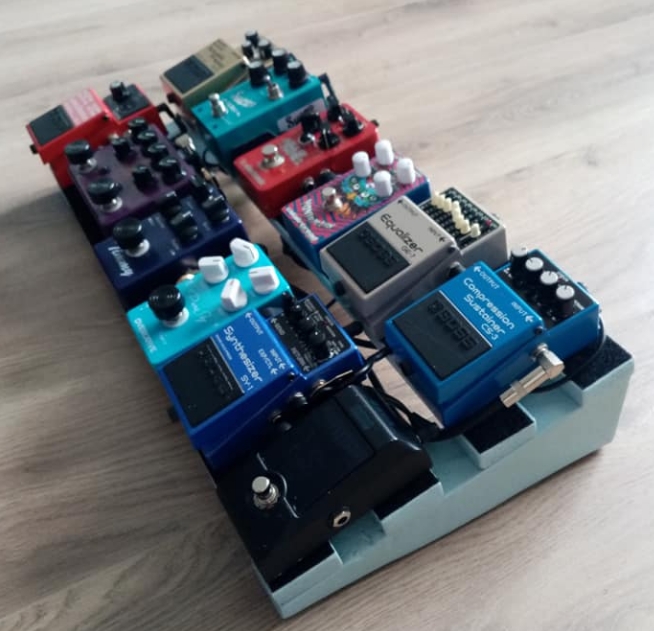
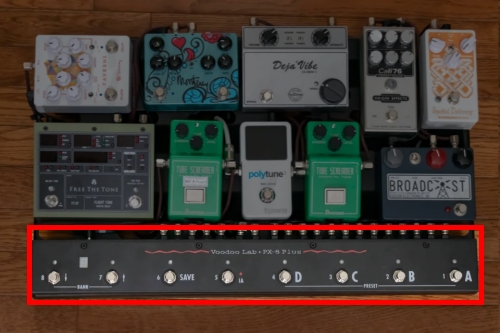
By now you’ve probably got a few pedals and have a fair idea of how to power them effectively. Let’s look at how to hook them all up together on a pedal board.

Why Should I Bother?

The point of mounting your pedals on a board is to keep them together in a manner that’s accessible for your feet, portable, doesn’t take up too much space on stage and is lightning fast to set up for a gig. There are a few different ways to do this, but the most common method involves a slotted pedal board specifically angled to keep your power supply and cable runs underneath and out of the way.

You can easily invest a lot of time and money getting it all perfect, but you need not do this to be a “pro”. Consider Eric Johnson’s pedal board for a moment. He has one of the most sought after guitar tones in the world and plays like a beast. When he takes his pedals on tour, they’re taped to a panel of particle board any-which-way, with cable runs all over the place. It’s a hot mess akin to Homer Simpson’s failed BBQ pit, and yet no one could possibly argue that it doesn’t do the job.

Clearly a tidy and efficient pedal board isn’t a pre-requisite for being a pro. Perhaps Eric Johnson is just so damn good that he can successfully work with a rig that looks like a pedal-eating monster threw up on the stage. The rest of us rookies need all the help we can get, so let’s look at how we can get things in order.

The Board

Oddly enough most pedal boards more closely resemble welded together frames than boards. The point of this is to enable you to poke your cable runs underneath and keep them out of the way.

You’ll see some that are raised at the back to angle the whole thing towards the player. This provides better access to the pedals at the back of the board if you have more than one row, and also allows you to secure your power supply underneath.

There are heaps of commercially available pedal boards on the market, catering to a wide range of budgets and rigs. Pedaltrain is one of the more expensive options, but would be considered the industry standard.

Before diving in and buying a pedal board, consider your needs. Lay all your pedals out as they would be on a board, and then measure to see what size board you should get. I’d advise you to go a bit bigger than your current requirements, as two things are almost certain:

  1. They won’t fit on like you think they will
  2. You’re going to get more pedals. Don’t bother arguing with me, we both know it’s going to happen.

If you’re on a tight budget, do a quick search on “Hejne pedalboard” or “Gorm pedalboard”. Ikea makes a shelving unit which used to be called Gorm, but has recently changed name to Hejne. The shelves themselves are sold separately at such a low cost they may as well be free, and there is a long standing tradition of DIY guitarists repurposing these for pedal boards.


Safety Tip:
The floor might seem like an obvious place to work on your pedal board, as that’s where it would normally live. Bear in mind though that assembling a pedal board takes time and requires the use of your hands, not your feet. Use a table or a bench while you’re putting it all together. Your knees and back will thank you for it.

Attaching The Pedals


Velcro/Hook & Loop Tape

You’ll need to attach your pedals to the board somehow, and the most common way is with Velcro. It’s worth noting that when you choose a roll of Velcro to buy, if you see words like “heavy duty” or “extra strength”, this refers to the strength of the adhesive backing. The bond between hook and loop will be pretty much the same no matter what you buy.

The convention here is to put the loop side (the soft, fuzzy side) on your board and the hook side (with the stiff, spikey bits) on the bottom of your pedals. The world won’t end if you do it the other way around, but there are a few good reasons to do this.

  • If you use your pedals off the board, the hook side will provide more traction on carpet
  • Most of the pedal-using community do it this way. If you swap or buy second hand pedals and have the hook side on your board, your newly acquired pedals (also with hook side already on them) won’t stick to your board.
  • Doing it the same way every time means not having to stop and think about which bit goes on the bottom of the pedal every time you buy a new one.

It’s good practice to cover your whole board in Velcro instead of putting little pedal shaped patches down here and there. This gives you the freedom to move your pedals around on the board wherever you want. Also, if you only use a little bit of loop on the board, when you remove the pedal you’ll likely unstick the loop side with it.

You want as much of your board to be covered in Velcro as possible, so cut your strip a bit longer than you need, then trim it back once it’s on your board. This will prevent you from coming up short.

When you put the loop side on your board, peel back only a little bit of the backing paper, stick the small patch of exposed Velcro down and then slowly peel more back, sticking a little bit down at a time. You’ll have a better chance of keeping it straight and not bunching it up or getting bubbles than if you peel all the backing off to begin with and stick the whole thing down in one hit.

When you put the hook side on your pedals you might notice there’s not much room for Velcro. Don’t worry if you can’t cover the whole base of the pedal, a little bit of hook tape will do.

If your pedal has feet or risers preventing it from sitting flat on your board, you can unscrew them and keep them in a safe place. I’ve discovered that the feet of a Cry Baby wah will fit between the slats of a Hejne shelf, so if you use one of those for a pedal board, you don’t have to unscrew the feet off your wah.

Most Boss pedals (and pedals like them) have symmetrical base plates. This means you can take them off and put them back on inside out. The Velcro then goes on a flat surface and the label gets preserved inside the pedal.


Alternatives

If you want something to hold onto your pedals a bit better than Velcro, there are a few other options. The first thing I’d recommend is psychiatric help. Seriously, Velcro is fine. Your pedals won’t fall off, and you can easily swap them out or reposition them without fuss. If you insist on being inconvenienced every time you move a pedal, here are a few other things to look into:


3M Dual Lock

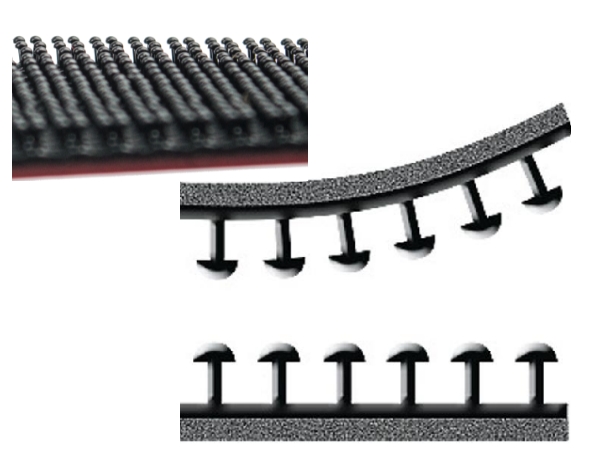
Dual Lock is a lot like Velcro, except instead of a hook side and a loop side, both sides are identical. It’s a network of interlocking mushroom shaped knobs, which when stuck together are almost impossible to separate. Almost. I’ve heard a regular butter knife and an up-to-date lexicon of curse words can help to separate board from pedal when you use this stuff.

I haven’t tested this myself, but apparently if you get a pedal that already has hook side Velcro on it, this will stick to the dual lock on your board as though there was dual lock on the pedal as well. Yet another reason to put the hook side on your pedal and not on your board.


Cable Ties

While using dual lock might seem a bit over the top, it’s something you’ll find professional international touring musicians doing. One of the more ghetto over-the-top solutions is the use of cable ties.

There’s a real art to getting the cable ties on without them getting in the way of jacks or knobs. If it turns out you’ve put your pedal in the wrong spot, you’ll have to cut the ties off, bin them, and start again with new ones. This approach is as neat as it is fun and practical.


Bike Chain

The side of a bike chain link forms a figure 8. One hole of this figure 8 gets screwed up into the base plate of your pedal. The other sticks out to the side so you can screw it down onto your board.

This method brings with it all the joy of disassembling a bike chain and needing to reach for a screw driver and a drill any time you want to move a pedal. On the plus side, those pedals aren’t going to move or fall off your board any time soon, and it can look fairly neat.

Connecting your pedals

Next you’ll need to connect your pedals up to each other. I’d recommend using patch cables instead of solid couplers.


What’s Wrong With Solid Couplers?

For starters, most pedals have their jack sockets in different positions. Those which do actually line up will also tend to have their sides slope in on an angle (the top of pedal is slightly smaller than the base of the pedal). This means that a jack plug is going to extend out of the socket at not-quite-90-degrees. Pedals joined with solid couplers won’t be able to sit flat next to each other. If you make them do so by adhering them to a pedal board, you’ll be applying upwards force on both jack sockets which could lead to them being damaged. A whole lot more force is added every time you step on a pedal to use it.

Connect enough pedals together with solid couplers and they’ll form a circle

Replacing a damaged socket might not be that big of a deal, but if those sockets are mounted directly onto the circuit board, that could get damaged as well. In that case, good-bye pedal.

Even if the sockets line up exactly (they won’t) and you mounted your pedal super securely to the pedal board, stepping on it will still introduce a small amount of movement. It might take longer for damage to happen, but it will happen.

Then there’s these bastards:

These offset or “Z” couplers might seem like a decent work-around. The trouble is that when you apply that downward force, they tend to want to rotate, which is even worse for your pedals.

Using a patch cable instead means the connection between pedals remains flexible, and any movement is isolated to the pedal you’re stepping on.

Some people will tell you they’ve used solid couplers for years and never had a problem. That’s fantastic news for them, but it doesn’t negate everything I’ve said so far. Imagine if your neighbour said they haven’t locked their front door in years and yet they’ve never been robbed. That doesn’t mean it can’t or won’t happen, that it hasn’t happened to other people, or that you should follow their naïve example.


Soldered vs Solderless Patch Cables

You’ll find much debate online about whether you should go for soldered or solderless patch cables. The argument in favour of soldered cables is that a soldered connection is about as secure as it gets, and any solderless solution is going to be a compromise. The argument in favour of solderless cables is that if you’re inexperienced with a soldering iron, your joins are likely to be bad, and a good solderless connection is better than a bad soldered one.

Both points are equally valid, and the decision to buy one over the other comes down to how well you can solder. That’s for you to figure out.
Whichever one you go with, cut your cable a bit longer than you need to make sure there’s enough length to bend around the slats of your board and actually make a connection without being pulled tight. A little bit of slack is good. Besides, you can cut down a cable that’s too long, but if it’s too short it’s useless.

Personally I buy pre-manufactured patch cables. The length might not be 100% what I’m after for every pedal placement, but I can get close enough without having to assemble cables myself. If you take this path, once again just make sure you’ve got enough length.

A quick word on braided cables: These things are great for long cables like the one that you plug into your guitar, or from your pedal board to your amp. They prevent kinks and tangles, and keep your cable relatively straight. With short patch cables though, you want as much flexibility as possible. Getting around the slats on your board and connecting to your pedals requires sharp turns that can’t be made with stiff cables. I’m not sure why short, braided patch cables exist, but they’re not much good for pedal boards.


Cable Direction

Its good practice to have your power cables running 90 degrees to your audio cables, or keep them separated as much as you can. There’s a possibility you’ll encounter noise and interference if you bundle them all up together in the same direction.


Do I Need a Loop Switcher?

The longer the path between your guitar and amp, the more top end you’re likely to lose from your tone. If you have a lot of pedals on your board, even when they’re turned off, the signal path to your amp is considerably longer than if you plugged straight into the amp.

You can get around this by using buffers. Most Boss pedals have buffered bypass, so chances are you already have some buffering in your signal path and don’t need to worry about this.

The other work around is to use a true bypass loop switcher. This will get every pedal completely out of your signal path until you select them on the switcher. If you have more than five or six pedals in your chain, and your signal seems to have lost a noticeable amount of top end, a loop switcher might be worth trying.

The other thing switchers are good for is enabling access. You could have all your pedals routed through the switcher, and then access them from a single neat row of buttons at the front of your board. This greatly cuts down on having to step over a row of pedals to get at the one you want.

Another access benefit of switchers is cutting down on “tap-dancing”. Say you want to change from one sound to another mid song, but doing so requires turning three pedals on at the same time. If those three pedals are in the same loop of your switcher, you need only step on one button to activate all three pedals.

There’s not a lot to consider when buying a loop switcher. Cheaper ones will have cheaper parts, so in theory the switches you step on every time you play could wear sooner than higher quality ones.

A simple switcher could in theory be entirely passive. It’s a mechanical device that re-routes your signal without the need for electricity. You will of course need some small amount of power if you want an indicator LED for each switch. More complicated switchers have digital controls which enable you to program different combinations of pedals to each switch.

One thing few people consider when buying a switcher is how far apart the sockets are on each loop. If your jack plugs are wide, they might not fit side-by-side in a looper with closely positioned sockets. You could fix that by getting patch cables with narrower jack plugs, but it’s something to think about.

That’s all for now

We’ve covered choosing a board, securing your pedals to that board, dealing with patch cables, and looked at whether or not you might benefit from a loop switcher. Next time we’ll look at your signal chain. Deciding what order to hook your pedals up in is a big deal which will have a huge impact on the sound that comes out.

Intro to Pedals Part 3: Power Supplies

So far we’ve looked at why you might want to alter your sound with pedals, and outlined a sensible approach to discovering which pedals might be relevant to you. I’ve covered how multi effects units aren’t completely useless, but that few people stick with them, they don’t hold any re-sale value, and as such aren’t where you want to spend the bulk of your gear budget.

If you’ve been following so far you’ll probably have a few pedals and have plugged them in and started having fun with them. It’s time to start thinking about power solutions.

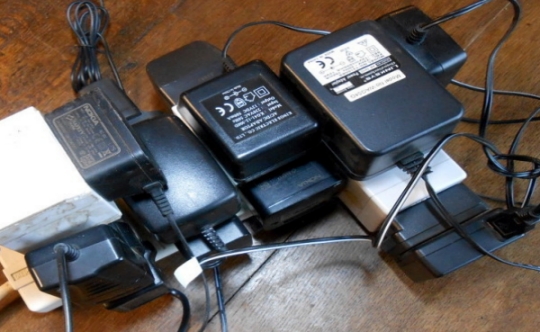
Powering pedals can be fairly impractical. You’ll either go through a lot of 9 volt batteries or have a comical arrangement of wall-wart power adapters. Surely this isn’t what the pros do?

There are of course more practical solutions. Before we get into those, we’ll need to pause for a moment and get a boring but essential bit of science out of the way. When plugging a power lead into a pedal you always need to consider four things:

Voltage, Current, Polarity, and Isolation


Voltage

Most pedals operate at 9 volts, some require more, and some can take more (eg overdrive pedals with different amounts of headroom available). Not providing enough voltage might not damage your pedal, but it will quite likely sound horrible. Providing too much voltage will almost certainly fry your pedal. Before you power up a pedal, be sure of its voltage requirements.


Current

This is a simple concept which confuses many. Current is measured in amps (A) or milliamps (mA), and is a way of measuring how thirsty a device is, not a limit on how much electricity you can throw at it. The mA requirement of your pedal is the minimum it requires to function, and likely how much it will draw from your power supply.

It is perfectly safe to connect a 200mA power supply to a pedal requiring 100mA. The power supply will make 200mA available, but the pedal will only take the 100mA that it needs. If a power supply doesn’t provide enough mA, the pedal won’t function properly or even turn on. Best practice is to have your power supply offer more mA than your pedal requires.


Polarity

Like the tip and the sleeve on your audio cables, power cable connectors have two separate parts to consider. They will either be centre positive or centre negative.

Most pedals will be centre negative, but occasionally (like with some old Proco Rats) you’ll get one that’s centre positive. Be sure of which way around your power lead is, and which way your pedal is designed. If you get this wrong your pedal will either simply not turn on, or end up completely fried. Toss a coin. Whatever the outcome, you’re not going to be using that pedal today.


Isolation

This refers to making sure your pedals don’t share a ground connection.

Pedals often use their ground connection like a sewer line. They dump certain audio frequencies (like the clipped part of your signal in a drive pedal) by sending them to ground. If you hook your pedals up so they share a ground connection (think “pedal sewer line”), these audio artefacts, along with some electricity, could end up being reintroduced to the audio signal of other pedals in your chain. Just like you wouldn’t want your neighbours’ sewerage backing up in your house, your pedals don’t want to be awash with crap from other pedals in the chain.

This could result in anything from a mild, low level hum all the way through to crazy, high-pitched, whistling oscillation noises which can be tricky to troubleshoot.

For example, some folks will complain that a delay pedal at the end of their chain is making a weird noise, when in fact a fuzz pedal at the start of the chain is generating it. It might just be that only the delay pedal is picking it up and making it audible. The solution is not to remove the fuzz or the delay, but to make sure they’re not sharing a ground connection.

So What Should I use?

Daisy Chains

The first thing most rookies try, no doubt because of the low cost and simplicity of it all, is to daisy chain your pedals. This involves one power adapter which plugs into a series of connected cables. This might work for some pedals some of the time, but is generally considered a horrible idea.

All of your pedals are drawing their power from the one source, potentially under-powering them, leading to them not functioning correctly and not sounding quite right. The more noticeable problem though is that they all share an earth connection which could lead to audio interference between pedals (see isolation section above).

If you insist on doing this, you can get away with it under some circumstances. I’d maybe consider it if you have a simple pedal board with only a tuner and a drive pedal or two.

Mixing digital and analogue pedals seems to be the main issue. I believe analogue pedals tend to generate most of the noise in a shared ground connection, while digital pedals pick it up and make it audible. While we’re at it, digital pedals should probably be isolated from each other too. When it comes to power, they just don’t play well with others.

Of course, make sure the adaptor at the start of your daisy chain is providing the correct voltage and enough current for all of your pedals. You’ll typically want a 9v adaptor with a crazy high current. Add together the mA draw of all the pedals you’re going to daisy chain, and make sure the power supply can offer at least that much, preferably more.

1 Spot are the kings of daisy chain solutions, while most other budget pedal brands like Mosky, Donner, and Joyo tend to have something on offer.


Power Bricks

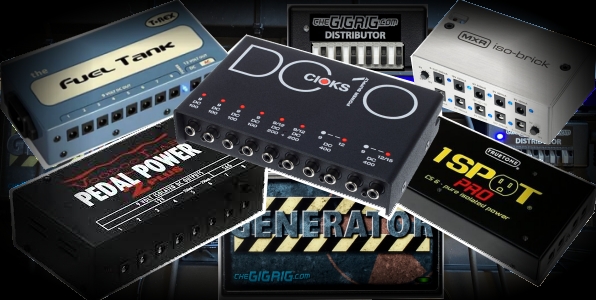
You can buy a power “brick” which takes up only one wall socket space, will convert your AC mains power into DC power at the correct voltage for your pedals, and will have multiple outlets for your pedals to plug into.

They vary massively in price, so let’s have a quick look at what you’re paying for and which features might be important to you.

Some bricks provide surge protection, and most should provide clean, regulated power to your pedals.

The main thing which separates the cheap power supplies from the expensive ones is isolation. The whole point of getting one of these is to provide isolated power to your pedals, so it makes no sense to get one which doesn’t. There are inexpensive ones which are nothing more than a tidier version of a daisy chain solution, offering no isolation whatsoever.

Maddeningly, some claim to be “isolated” while not actually being isolated in the sense we’re thinking of. The power supply itself is isolated from other devices, sure, but we want each of its outputs to be isolated from each other. Look for the words “isolated outputs” or something like that. Don’t be content with merely seeing the word “isolated” in the product description.

The number of outputs will have an impact on the price. Get one with more outputs than you think you need. I don’t care if you think you have all the pedals you’ll ever need to power up, I know you’re lying to yourself even if you don’t. If you get a five outlet power supply, don’t come crying to me when pedal number six shows up and you have nowhere to plug it in.

However much you save by getting the smaller power supply, think of how much more expensive it will be when you have to buy a second one. It will happen. You’ve been warned.

Some will come with a few outputs which are a higher voltage. This can be handy if you have pedals which require more than 9 volts, or it could be a waste of an output if you don’t. Some of these will be switchable between 9 volts and 12 or 18 volts, which is the best option. Just make sure you’re not paying for a power supply with outputs you can’t use.

Just like with the daisy chain solution, you’ll need to figure out how much current you need. Add up the mA of all of your pedals, and make sure the power supply you get can deliver equal to or greater than that amount. There’s no point getting a power supply with over 20 outputs if it only has enough mA to drive one pedal.

Also consider the size of the power supply. If you intend on sticking it underneath a pedal board, you need to make sure it will fit.

It used to be the case that no modest budget power bricks were isolated, and if they said they were, it was mere marketing trickery. That’s not the case as much these days. Check the specs and read reviews. You’ll find many units where someone has bought one and tested the outputs with a multimeter to confirm if they are indeed isolated.

At the budget end of the spectrum, have a look at Caline and Mosky. At the more mid-priced to professional end have a look at:

Probably one of the most expensive yet best value power supplies on the market is from GigRig. They provide a modular solution, meaning when you run out of outputs, you’re not stuck having to buy a whole new power supply. You can simply buy another adaptor with more outputs and plug it into an output of the unit you already have.

To kick start the whole thing, you buy their “Generator”. This provides clean, regulated, surge protected power at a whopping 5 Amps. From there you plug in a “distributer” which gives you 4 outputs. Into each one of those outputs you can plug in an “Isolator” which each provide 4 isolated outputs. This results in 16 isolated outputs. If pedal number 17 ever turns up you can get another isolator and plug it into one of the outputs of one of your other isolators.

GigRig pride themselves on being the best in the business when it comes to durability, quality control, aftermarket support, and most importantly making sure your guitar tone remains pure and untainted. For the record, I don’t have an affiliate marketing arrangement with the GigRig. It’s common knowledge in the industry that GigRig is the Rolls Royce of pedal power supplies.


Next time we’ll look at pedal boards themselves, patch cables, and a few things to look out for when putting it all together.

Intro to Pedals Part 2: Choosing Pedals

So you’ve decided that you want more from your guitar sound than what you get when you plug straight into your amp. It’s time to get a pedal or two, but which ones should you be checking out to begin with?

Multi Effects Units

A fairly common way to get an idea of what’s what, is to get hold of a multi effects unit which supposedly has everything in it. It’s significantly cheaper than buying one of every kind of pedal in existence, and side steps having to deal with mounting them to a board, hooking up lots of patch cables and worrying about power requirements.

If you have access to one of these, maybe on loan from someone else or acquired second hand for some freakishly negligible cost, it might be helpful to play with. You can scroll through all the effects while making an awful racket and taking note of which ones you find interesting.

I’ll stop short of recommending you spend significant money on one of these units, or spend a significant amount of time trying to sculpt a usable combination of sounds with one. I would strongly discourage buying a new one at full retail price.

What will inevitably happen is, over time you’ll discover at least 60% of the sounds in that unit are of no interest to you, and those that are happen to be important enough to you that you want a decent quality version of that effect in an individual pedal. I can’t think of a single guitar player who started out with a multi effects unit and went on to use it exclusively throughout their professional career.

Resale value on these things can be punishingly low, so selling it on once you’re done with it seems hardly worth it. This is not where you want to invest the bulk of your gear budget.

Having said all that, many professional musicians do occasionally gig with top quality modelling gear when they’re travelling light or they don’t want to take their expensive vintage equipment to a particular gig. Worthy of note among these are the Line 6 Helix range, and Neural DSP Quad Cortex.

Those aren’t cheap though, and for the same or less money you could buy one of the actual amps or some of the effects that they’re trying to sound like. Why not have the real thing? When you buy modelling equipment you’re paying for access to a vast range of sounds, most of which you’ll never use.

This brings us to the most important question you need to keep in mind when shopping for pedals: “What are the effects I need in order to generate the guitar sounds I want to play?”

Knowing What to Use

Put together a playlist of the kind of music that you’re likely to play on guitar. Listen to what effects the guitarists in those recordings are using. This will be your starting point. I’m going to make a few suggestions here but you don’t necessarily need these pedals to play that music.

Get a Tuner

OK forget what I just said about not needing the pedals I suggest here. Every guitarist needs a tuner, and that means you, too. Pedal tuners are about the most practical on the market. When you consider the alternatives are either rack mounted, headstock/clip on tuners, or a pitch pipe, this just makes sense.

Important things to look for in a tuner are:

  • Accuracy
  • Tracking speed (when you pluck a note, you don’t want to have to wait for the tuner to “find” it)
  • Visibility in different lighting situations (consider dark/low light in a club versus bright sunlight at an outdoor gig)

The TC Electronic Polytune is hugely popular, and for what it’s worth I’m a big fan of the Korg Pitchblack Custom. While the visibility isn’t quite as impressive as the Custom version, the standard Korg Pitchblack performs much the same and costs a fair bit less.

You don’t have to spend a fortune on a multitude of features here, but you only want to have to make this purchase once and be done with it. This isn’t a fun or exciting pedal, and if you cheap out on something that’s a massive compromise, you might find yourself going through the banality of shopping for another one in the not-too-distant future. There’s no such thing as a “beginners tuner” so you might as well make the investment in a proper one straight away.

Your Average Rock Band

Straight away you’re going to need some sort of overdrive, and it’s quite likely you’ll only need one. If you’re going to play the odd lead break, you may want to also invest in a lead boost. That would sort most rock guitarists out, and this is reflected in the amount of “dual overdrives” on the market (essentially an overdrive with a second switch to engage a boost).

It’s not all that uncommon to want to make use of several different gain stages:

  • a light, just-past-edge-of-break-up overdrive
  • a more aggressive, higher gain overdrive
  • a lead boost

Stacking all of those into each other could also approximate a decent full-fat distortion in a pinch.

Your Average Covers Band

Covers bands play a bit of everything, so surely you’re going to have to get the lot, right? Not necessarily.

Assuming your amp already has reverb, you’ll be surprised just how far you can get with a range of different gain stages (see above) and a delay pedal.

Depending on the material you’ll be covering, you may want to get some sort of modulation. Most commonly this will be chorus and tremolo, but occasionally you may need a flanger/phaser/vibrato etc.

If you’re doing 60s rock covers, you’ll want to get a wah pedal, a fuzz, and maybe a uni-vibe.

The Heavy Stuff

If you’re playing heavy music, some kind of distortion is a must. A lot of metal guitarists will achieve this via an amp with a high gain channel. If you take this route, it’s still worth looking at some kind of lead boost. Consider how loud it is when the rest of the band is pummelling out a down-tuned heavy riff at full volume. Your tiny little single note lines don’t stand a chance of being heard in that mix without some kind of assistance.

Stepping on a Tube Screamer or some kind of Tube Screamer derivative at this point would help a great deal. It would tighten up your bottom end, increase your mids, and in doing so raise your most audible frequencies so the audience can hear you. If you crank the level knob you’ll also enjoy a cheeky increase in overall volume. Most lead boosts will operate like this: they’ll likely lift your upper mids and increase your volume.

If you don’t have a high gain amp, you’re going to need a distortion pedal. There are so many types of distortion pedal on the market I could dedicate an entire series of posts just on this topic. I’ll try to give you a quick over view to get you started on your search.

The good old fashioned Boss DS-1 was a go-to pedal in the 80s but is a bit too shrill and spikey sounding for some rigs. Dialling the tone knob all the way back on one of these might get you the exact sound you’re after without spending a whole lot. A Rat might be worth a look if you want something old school but a bit darker and thicker sounding. They’re kind of a cross between a DS-1 and a Fuzz Face.

If sludgy, doomy, fuzz-meets-distortion is what you’re after, check out the world of Big Muffs. There’s a lot of variation between the different Muffs available, so do your research and try a few out.

If you’re chasing a more modern, djenty sound, there’s quite a lot of options. Check out Deizel pedals for starters. This company is renowned for making epic sounding high gain amps, and they’ve done a decent job of capturing that distortion sound in their pedals.

James Brown (no, not that one, the guy responsible for the design of the Peavey 5150) now has a pedal company by the name of Amptweaker. His distortion pedals are next-level awesome. The MXR 5150 overdrive pedal is geared towards the distortion sound of that amp, and like the Amptweaker stuff, comes with a built in noise gate.

Music hasn’t sounded quite the same since either of these two guys came along.

If you’re looking to spend a little less, there’s the Hotone Djent. It looks like a toy but sounds like the business.

Conclusion

These are all just broad suggestions on where to start if you’re not sure. Whatever you run with for your first pedals, get cheap ones to start with.

Yes, I would discourage spending good money on a multi effects unit to try it all out, on the basis that you’ll probably move on from it and not get your money back. I will however encourage you to take a similar approach with a handful of cheap pedals instead. You might experience a few less effects, but you lose less money and focus on the more relevant pedals to your playing style.

While you figure out what flavour of overdrive or fuzz or distortion etc you’re into, you’re going to swap out and trade your way through a whole bunch of pedals. Better to do that with cheap ones first of all. Even if you start with expensive pedals, you can still be almost certain you’ll end up moving them on at a loss once you refine your tonal tastes.

Here’s how I’d recommend the commencement of your pedal journey:

  • Listen closely to recordings of the genre of music you’d like to play
  • Take note of the effects involved
  • Buy some cheap versions of those effects
  • Once you know what sort of sounds you like, have a look at which pedals on the market do a top notch version of that sound within your budget

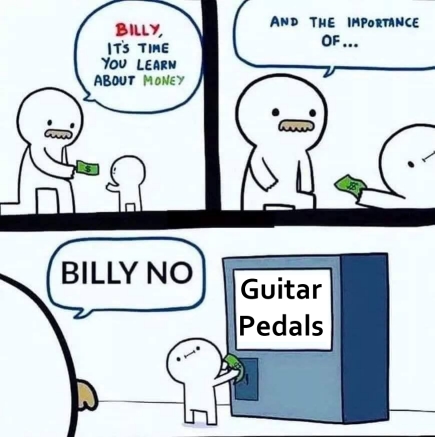
Just a word of warning: once you start experimenting with pedals, it’s a slippery slope towards full blown pedal addiction. You’ll quickly find all sorts of pathetic excuses to spend more than you should on just one more pedal. Always keep in mind what you’re trying to achieve with your tone before you browse for pedals, and likewise keep a close eye on your budget. You have been warned.

Once you’ve got a handful of pedals you’ll be wanting to hook them all up in a practical and portable manner. In my next post I’ll be exploring all the non-pedal parts of your floor based gear: pedal boards, patch leads, power requirements, and other stuff you could potentially lose a heap of money on through buying the wrong gear or cutting costs in the wrong area. This post will cover all the hidden expenses we forget about while lusting after the gear that makes cool sounds.

Intro to Pedals Part 1: Why Pedals?

As I was piecing together my own pedal board from scratch, I stopped to reflect on all the mistakes that brought me to this point. This whole blog was started to provide others with the information I wished I had when I was starting out, so they could avoid wasting money on the wrong gear for the job. To that end, I’d now like to specifically look into the world of pedals.

It’s a huge topic, and probably too much for one post. To spare everyone from having to scroll through a massive wall of text, I’ve decided to break it up into a series of posts.

For today though, let’s just dip our toe in the water with a couple of simple questions: “Why do I even need pedals?” and “Where the hell do I start?”

Why Do I Even Need Pedals?

Stop me if you’ve heard these before:

  1. *Insert guitar legend’s name here* used to just plug straight into their amp without any pedals, and they sounded fine
  2. Why worry about all that stuff? Tone is in the fingers!
  3. You wouldn’t need pedals if you had a decent amp
  4. Want to sound good? Get lessons and practice more! Then you won’t need pedals!

First of all, if anyone comes at you with that noise, there’s a particular guitar fingering exercise you can demonstrate for them which should serve as an adequate rebuttal:

Extend your fret hand towards them, and curl your index finger, ring finger and pinky towards the palm of your hand, locking them in place with your thumb. In this position, elevate your hand slightly, whilst adopting an exasperated facial expression.

This person is either incredibly ignorant of the wonderful world of guitar tone, or has no gear of their own and is adopting a “sour grapes” position to save face. For this reason, the finger exercise above should suffice as a response.

If however, you actually want to stoop to their petty level, here are a few considerations:

  1. *Previously mentioned guitar legend* probably played a style of music which didn’t typically make use of pedals, or they played in an era which predates commonly available pedals. They’d probably use every pedal they could get their hands on if they were around today.
  2. Hold your fingers up to your ears. Can you hear tone? No. All you can hear is bullshit.
  3. A high gain amp might negate the need for a distortion pedal, but you’ll be hard pressed finding one that’ll rock a wah. There are more pedals out there than just drive pedals and reverb.
  4. No amount of lessons and practice will make a nylon string acoustic guitar generate harmonic tremolo or octave fuzz.

The truth of the matter is that electric guitar is a unique instrument, quite distinct from its acoustic ancestor. Electronically manipulating the waveforms generated by your pickups is as much a part of playing the instrument as strumming chords and picking notes.

As an electric guitarist, your amp is as much a part of your instrument as the strings and frets. The same can be said of effects pedals.

So Where the Hell Do I Start?

I’ve seen people rush off and buy random pedals fuelled by the knowledge that they’re just a thing guitarists use and being bummed that they didn’t have any yet.

I’ve seen enthusiastic but not-so-helpful people advise new guitarists that they simply MUST have this pedal or that pedal, predominantly because that’s what they use and like.

The first place to look is not a catalogue of pedals, but your music collection. Listen to the style of music you intend on playing on guitar, and try to identify the sounds involved in the guitar tone. After all, pedals are but tools of the trade, so step one is to work out which tools will be required for the job at hand.

In my next post I’ll go over the process of choosing pedals for different musical circumstances. See you then.

Cheap Clone Pedals

If you’re on a tight budget but have found yourself hooked on pedal acquisition, you’ve no doubt discovered the wonderful world of “clones”. Thanks to a peculiar quirk in intellectual property law, it’s the look of a pedal and its name that you’re not allowed to replicate. You’re free to copy the circuit to your heart’s content.

Disclaimer:
Just to be clear, I’m not a lawyer, and this is my feeble, uneducated understanding of the matter. If you choose to do this you do so at your own risk. Please chime in on the comments section if you know what’s actually going on here.

The important distinction to make is that I’m not talking about counterfeits. I’m talking about pedals that are assembled in different enclosures and marketed with different names. Counterfeits do exist, but that’s not what I’m referring to here.

Anyway, cloning makes perfect sense in some cases. There are pedals like the Klon Centaur and Marshall Bluesbreaker that are long out of production, and can only bought for “collectors” prices. If the original manufacturer no longer makes them, where’s the harm in someone else having a go?

There’s a somewhat ethical grey area after that. There are boutique pedal manufacturers who build everything by hand, carefully measuring and choosing every component with painstaking quality control. They charge a fair price for such effort and craftsmanship, which happens to be more than most folks want to pay for a mere tonal tool.

With this approach comes a long waiting list for your pedal to be made. Analogman’s King of Tone notoriously has a 2-3 year waiting list. So if you can’t stomach the wait, you might want to consider the used market. Knowing the waiting list creates scarcity, used versions of these sell for highly inflated collectors prices.

What’s an impatient, cash-strapped muso to do? Clones of these pedals which are available for a small fraction of the price get awful tempting. You might justify it by thinking that the original manufacturer is already selling more than they can make, so they’re not missing out on sales. After all, is a mass-produced cheapo unit really competing with hand built boutique pedals?

I’m not going to weigh in here. On one hand I have massive respect for boutique builders. On the other, I have a modest income, yet would still like to participate in the pursuit of guitar tone. So whether you throw stones from your ivory tower in defense of boutique builders, or bypass the builder and gather cheap imitations without regard, I’m not here to judge. You do you.

Are clones as good as the real deal?

Yes and no. On the one hand they typically have the same circuit, and as such will (in theory) sound and function exactly the same. In order to mass manufacture something at a cheaper price point, quality control corners often get cut and cheaper components become a must.

Ironically enough, the cheapest generic brand pedals tend to be closest to the original circuits. They’re not looking to re-invent the wheel, so going with what’s already there is a quick and easy solution. In the meantime, mid-priced brand name pedal manufacturers tend to want to make their own pedal, merely inspired by the original. Their own spin on it might be better, worse, or just plain different.

A great example is the EHX Soul Food. Inspired by the Klon Centaur, opinions all over the net are divided over whether it differs too much with its brash high frequencies, or whether it’s a welcome fresh take on the original. Meanwhile, the Mosky Golden Horse gets universally praised for doing more or less exactly what a Klon should, for around half the price of the Soul Food.

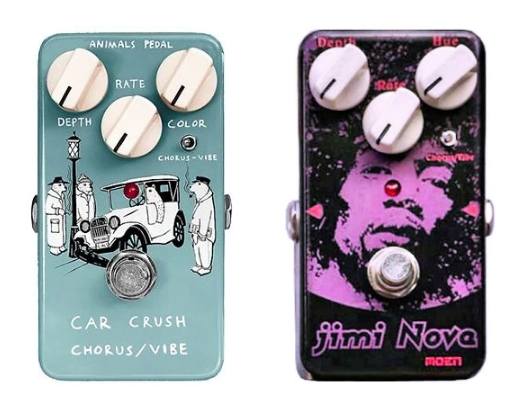
In my quest for a decent uni-vibe style pedal at a budget price, I discovered the Animal Pedals Car Crush. Animal Pedals are put out by One Control who are best known for making respectable, mid-priced loop switchers. The Car Crush was the cheapest vibe pedal I was aware of that made use of a photo cell circuit.

I asked online for recommendations for other cheap photo cell vibes, and if anyone had experience with this one. One helpful soul opened his much cheaper vibe pedal, the Moen “Jimi Nova“, and compared it to the innards of a Car Crush. Wouldn’t you know it, they’re the same pedal, but the Moen one costs half the price.

The artwork on the Car Crush is way cooler, and you might have some of your peers turn their noses up at the sight of a generic Moen pedal on your board. Whether it’s worth twice the price to rectify that is a question for your conscience.

What do I need to be concerned about with cheaper pedals?

Moving parts
The most obvious things that can go wrong with any device will likely involve moving parts. Check for flimsy switches, and free-spinning knobs that do nothing to affect the sound. Make sure the input and output jacks are ok.

Power
If you plug a switched on power lead into a pedal, the split second before a firm connection is made could result in a bit of a power spike through the pedal. More expensive pedals will likely have some small amount of protection built in, while the cheaper ones will end up fried before you’ve played a note.

I’ve heard anecdotes of this happening to Mosky pedals in particular. If all the generic brands are using the same circuits, they’ll all likely be just as susceptible.

Best practice is to plug your power in first, THEN switch the power on. Still, it’s nice to know if the connection wasn’t as firm as you thought it was, you haven’t killed your pedal.

Noise
This is particularly a problem for pedals with plastic enclosures that aren’t well shielded. That’s not to say all plastic pedals suffer from this, but they are the main culprits.

There are also some pedals which function with a high noise floor. You might consider fixing this with a noise gate, or spending a little more money on the original purchase and finding a better version without so much noise. Then again, maybe your tolerance to the noise makes it not a problem. This is just something to weigh up when trying cheap pedals.

The Bottom line

Nothing comes close to the quality control, aftermarket service, and sense of community you find when you purchase a top end pedal. The expression “buy cheap, buy twice” definitely holds true here as well. Then again, you shouldn’t let a tight budget stand in the way of getting amongst it while cheaper options are available.

How much should a guitar really cost?

There’s a huge price variation from one end of the spectrum to the other on the guitar market. Somewhere between the $50 “beginner” guitar and the $50,000 “collectors dream” lies a sensible sweet spot for your every day musician.

I’m going to try to help narrow that down. With the aid of a little perspective we’ll look at where you can expect to find the limits of the disposable toy price bracket and the brand name bloat price bracket.

As far as possible I’m going to try to avoid using actual dollar amounts to remove confusion over which currency I might be referring to, as well as inflation and price variation over time.


Back to basics: what does it cost to make a guitar?

First of all, let’s look at the timber. We all know the commonly used timbers for guitar building: mahogany, maple, alder, ash, and if weight is a consideration (or you’re an insufferable tight ass) bass wood.

Have a google around your local timber suppliers and have a look at the price tag on a decent slab of those timber species. Right off the bat this is starting to look prohibitive.

Now consider the cost of turning that timber into something playable. Some of you might consider shaping a guitar body yourself without too much difficulty. Fair enough.

Nailed it!

How about the neck though?

Sometimes you’ll find your local luthier or repair guy will post the cost of a re-fret on their website. Try to find that.

Now pick your chin up off the floor and consider this: if that’s what it costs to rip the old frets out and put new ones in, think about what it would cost to build the whole freaking neck from scratch.

This would be a great point to consider what you think would be a fair hourly rate for a skilled luthier to be paid.

With that in mind, let’s talk about finish. Paint, stain, lacquer etc isn’t free, and it takes time to apply. A lot of time. However long you think it probably takes to sand a piece of timber flat enough to apply finish, its likely twice that. Multiply that by the hourly rate you previously came up with, and you have a ball park figure of the cost just to make it look pretty.

You can easily get up around the $1500 – $2000 mark to have a luthier put together a fairly basic, nothing-fancy guitar. Mind you if you do this, you’ll have a one-of-a-kind, hand made guitar built to your specifications which will be worth every penny and then some.

If you have that kind of money spare you should definitely do this. You’ll be supporting your local luthier and end up with something really nice for around half the price of certain popular big brand name guitars. Quality control will likely leave the big-boys in the dust as well.

Although, there’s a fair chance that if you’re reading this blog you don’t have that kind of money to invest in a new guitar. The obvious question then is:


How can this whole process be made cheaper?

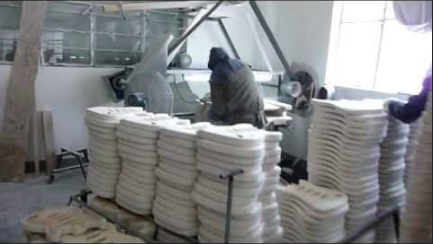
The most obvious thing to lower the cost is economy of scale. Bulk buying timber and hardware, shaping everything on CNC machines and assembling everything on a production line smashes the price down to next to nothing.

Despite this, labour still adds a significant cost. Someone still has to sand and finish these guitars, and CNC machines aren’t going to tackle fret work or check your intonation.

The cost of that labour varies depending on where in the world it happens. Knowing where your guitar was built can be a good indicator of what you’re paying for. China is notoriously cheap with its labour costs. That cost doubles if your guitar is made in Indonesia, double that again if it’s made in Korea, and more than double that figure to get one made in the US.

Some folks equate cost of labour with quality of labour. While there is definitely a case to be made for a reasonably consistent correlation between the two, it’s not always the case. You occasionally see good work coming out of China and glaring quality control oversights coming out of the US.


How low can you go?

There’s a few cost-cutting practices used with cheap guitars that have become fairly common practice.

You’ve no doubt noticed the beautifully figured flame/quilt/spalted maple caps on Les Paul style and PRS guitars. There’s no way you’re getting an actual maple cap on budget level guitars, so what’s going on here?

The most common method is to utilise a veneer. Aesthetically speaking, there’s nothing wrong with that, and some of them can look quite nice. They’re stained and finished the same way as their more expensive counterparts, and if you didn’t notice the price tag, you’d have a hard time telling it wasn’t the real deal.

Far less common and far more sinister is the use of an inkjet print-out under a clear coat, in an attempt to avoid using even a veneer of the proper timber or bearing the cost of applying a proper finish.

The fewer pieces of timber that get glued together to make the body of your instrument, the better it’s harmonic resonance and sustain. Finding one or two large slabs of wood with no knots or chips in it is difficult though, so where they exist, they come with a premium price tag.

The obvious cheap work around is to use many pieces of timber laminated together and cut to shape. Three or four piece bodies are fairly common and aren’t anything to worry about, but you’re starting to creep into compromise territory after that. Chances are if you’ve bought a cheap Asian guitar with a solid finish or a veneered top, they’ll be covering up a patch work collection of timber off cuts glued together.

To be clear, the sonic impact of doing this isn’t massive. There’s a good chance you won’t notice. Having a one or two piece body is just one of the many small things which work together in aggregate in a more expensive guitar to make you go “wow this guitar sounds so much more impressive than the cheaper guitars”.

Another production money-saver is using “pot metal” for the hardware. Pot metal tends to be a mash up of different kinds of recycled scrap metal. It lacks the usual structural integrity you might expect and can’t really be relied upon. If you’ve bought a dirt cheap Asian guitar you’d be well served to upgrade the bridge and tuners.

So that’s all there is to know about what you’re paying for when you buy a guitar right? Not exactly. Materials and labour probably make up about a quarter to a third of the retail price.


What you’re really paying for, and how to get around it

Everyone who handles the guitar wants a percentage of its value. That includes marketing, warehouse costs, shipping costs, retail mark up etc. By the time it hits the display at the retail store, that guitar has likely quadrupled in price.

It can be maddening to know that the majority of what you’re paying for has nothing to do with the cost of building the guitar. Here are a few things to consider if you want to beat the system:

  1. Get a cheap Asian guitar and upgrade its parts
    Once upon a time cheap Chinese guitars were unplayable pieces of junk. A lot has changed over the years, and while there are still likely to be a few quality control issues, the standard you’ll find these days is much higher.

Find an inexpensive guitar from a decent species of wood. Replace the pickups, tuners and bridge. Take your new guitar to your local luthier and recruit them to put it all together, give it a set up and get it playing like a professional quality instrument.

That whole process may cost you twice as much as the guitar itself. Bear in mind though, that if all these upgrades were already in place at the point of manufacture, you’d be paying four to five times the price at the retail end. An extra $100 on pickups at the start of the process adds $400-$500 to the total cost of the instrument by the time it gets to the shop.

  1. Buy second hand
    The cost of a decent second hand instrument should be in the same ball park as option one above. Realistically though, it’ll probably cost a little bit more, and will likely still end up in the hands of your local tech for a look over and a set up. This way though, you don’t have to deal with the social stigma of having a budget brand’s logo on your guitar.

The major advantage of buying second hand is you have a sporting chance of getting some money back when you sell it. If you have a high-end, well known brand of guitar it should retain a respectable resale value. Hardly anything else will.

  1. Buy a kit guitar and DIY
    I’m cautious about recommending this approach, but you may want to consider it.

Getting a kit guitar intercepts the whole process pretty close to the start. The same factories that churn out necks and bodies for well known brands also provide necks and bodies for kit guitars. By getting a kit you’re not only removing the cost of shipping and marketing, you’re also removing the cost of finishing and assembling the guitar by doing it yourself.

What might not be obvious is that you’re also skipping the quality control nip-n-tuck that most guitars get before moving on to fit and finish. The neck pocket might be a bit off, the fret work could be appalling, there could be a rough looking gap between the veneer and the binding – you get the idea.

This could potentially be an inexpensive way to end up with a unique guitar built to your specifications. It could also be a painfully frustrating and expensive lesson in why most folks leave guitar building to the experts.

Only do this if you’re equally motived to gain experience in guitar building and don’t mind the end result looking as amateur as it actually is.

If you do go with this method, give Pitbull Guitars a go. There are higher quality kits available, but you’ll have zero interaction with the supplier beyond adding the kit of choice to your kart and providing payment and shipping details.

With Pitbull you have a native English speaker operating the front end of the store who is more than happy to have a bit of to-and-fro by email to discuss customisations and modifications to standard kits. He’s also well aware of the unavoidable quality control issues with Chinese factories, and goes above and beyond in the name of customer service if what you receive doesn’t measure up.

At the premium end of the spectrum is Warmoth. By all accounts their quality control is fantastic and they come with a large range of customisations. You can even get them to do some of the finish and assembly for you.


How much should you spend?

So now you’ve got a decent idea of what you’re paying for when you buy a guitar, and hopefully that’ll give you some perspective on what a reasonable price to pay might be.

If the retail price of a guitar is dirt cheap, imagine what sort of quality parts and labour you’d get for a quarter of that price. If that thought horrifies you, walk away from the guitar – it’s likely junk.

Likewise, if the price tag is more than the cost of having a luthier build you a guitar by hand from scratch, they’re probably charging too much. You’re likely paying for a brand name and the reputation of the company rather than tangible improvements in build quality, playability or tone.


The Bottom Line

Being a guitarist is expensive. None of the gear is cheap, and if you buy some that is, you’ll spend a lot more along the journey towards discovering what you should have bought to begin with.

Have a long hard think about the sound you’re after, do your research into what type of gear can make that sound, check out reviews of equipment on your short list, and try to play that gear before you buy it. Try to make decisions based on what’s practical and appropriate, not based on the latest trends, flash marketing, or internet hype.

WARNING: Does your guitar have a nitro finish?

A lot of vintage guitars (and vintage re-issue guitars) have been finished with nitrocellulose lacquer. It’s usually applied fairly thinly, so you can still kind of feel the grain of the timber underneath. There’s an argument that not encasing your instrument in a thick layer of poly allows it vibrate more freely.

Many folks swear by guitars with a nitro finish and find any other kind of finish an abomination. Nitro finished guitars have a distinct look, feel, smell, sound, and for all I know, taste.

Howlin Wolf demonstrates his unique guitar licks


So what’s the problem?
Nitrocellulose lacquer never fully hardens, so it’s very easy to end up with dings and marks in it. It also happens to react with a bunch of common substances, making it quite difficult to preserve your lovely finish. When you consider that most guitars with a nitro finish happen to be reeeeeeaally expensive, that’s more than a little inconvenient.


What do we need to look out for?
While nitro seems to be allergic to just about everything, the main culprits tend to be rubber, vinyl, and plastics.

Unfortunately, finding a stand that doesn’t contain at least some of these at its contact points with the guitar is almost impossible. With at least 90% of all guitar stands being unsuitable, the safest place to keep your axe is in your hands or in its case.

I’ve heard horror stories of guitars left in stands where the finish had worn or degraded down to bare timber due to a chemical reaction with the stand.


How do we get around this?
First of all, there’s the utterly ghetto “raided laundry” approach. There’s nothing more incongruous than seeing a guitar worth thousands of dollars in a guitar stand with old socks or a cut up shirt draped over the contact points. It works, but you’re not exactly going to look like you have your act together in front of your musical peers.

Some folks cover the rubber contact points on their stand with a cut up garden hose, not realising the hose is made of PVC which is just as bad.

If you’re eyeing off a can cooler for the job, forget about it. Neoprene reacts with nitro as well.

Leather might work, but be mindful of any tanning or conditioning chemicals which may have been involved in the manufacturing process.

I know what you’re thinking: “if nitro finished guitars have been around for about 70 years or so, surely someone would have invented a suitable stand for them by now?”

There are a few options available, but I recommend extreme caution.


Hercules Stands
Many people swear by Hercules guitar stands. Anecdotal evidence from discussion forums would indicate that their “specially formulated rubber foam” doesn’t react with nitrocellulose. The company itself makes no such claim though, and if there’s even a trace of actual rubber in that foam, you’re in for heart break down the track.

I’ve heard at least one report of a small section of exposed plastic contacting a guitar and reacting with the finish. If you use a Hercules stand, just make sure only the padded parts of the stand contact your guitar. Otherwise it’s a bit like saying “sure the condom had a hole in it, but hey, at least I wore one”.

Hercules stands might be ok, and by all accounts they are, but I’m not sure I could bring myself to put a 1958 Les Paul in one.


String Swing
Likewise, a lot of people swear by String Swing products. The company thinks their products are fine for nitro, but stop short of offering a guarantee to that effect. This is from the FAQ section of their site:

Q: Are your products safe to use for guitars with a nitrocellulose lacquer finish?
A: Our material will not eat into the nitro of your guitar like most foams and rubbers do. Fender, Gibson, and Martin, all use our products in their showrooms, and for trade shows on their standard and high nitro finished guitars. However, there are some things that are out of our control that prevent us from putting an unconditional guarantee that no marking will ever occur.

  1. If an issue does arise there is no definite way for us to tell if the marks were caused by our products or if they were from a previously used product from another manufacturer.
  2. If you have used a guitar polish, be sure it is wiped off before you use our products. There is conflicting information on the internet as to whether polish is ever necessary or not. Also, along these same lines, do not use any chemical cleaners on our padding material. Water is fine if needed.
  3. Guitars being stored in any sunlight can be a big problem, regardless of what material is being used in resting the guitar.
  4. Nitro finish remains partially a liquid for its lifetime, so extended periods of time any significant pressure on the finish can result in pressure marks almost like a smear. This is worsened if the guitar was not given proper cure time when the finished was applied.

All of this being said we still have the safest material on the market for a nitro finished guitar and thousands of people trust hanging them every day. Also, if you have a nitro white Gibson, or Epiphone we have white yokes that we recommend for these extremely color sensitive finishes. If you decide to choose our products to display your guitars, for your peace of mind, we suggest that you check your guitars occasionally to be assured of their safety.


K&M Stands
This company specifically states that their stands are designed to not harm a nitro finish. Turns out the contact points are covered in either molded cork or thermoplastic elastomer, depending on the model in question. This is probably a winning solution, but it might be worth finding out what has been used to bind that cork.


It’s Not Just Stands…
While you’re getting paranoid about letting anything come into contact with your guitar, consider what else touches it:

  • Have a long, suspicious look at that capo before you clamp it on the neck.
  • If you use one of those tuners which clamp onto the head stock, be careful.
  • What are you using to clean or polish your guitar?
  • How about your hands? Soaps, lotions, and sanitizers etc can cause damage.


What about inside your case?
Maybe remove the strap from your guitar before locking it in its case: what are the chances it’s been manufactured with vinyl, rubber, or bits of plastic?

Do you wipe your guitar down with a rag after playing it?
Good for you!
Do you store that revolting sweat-sponge in your case with your guitar?
What the hell is wrong with you?

Not only will this introduce a stench to your case that will require an exorcism to remove, but a dubious rag with a potentially unknown past could be damaging your finish. Remove that rag immediately and apologise to your guitar. Hug it, and beg its forgiveness. Buy it flowers. Just don’t let the flowers touch the finish, because, well…

“I will eat your nitro”


It’s Probably Not That Bad
There is a lot of contradictory testimony over the fragility of nitrocellulose. A quick google search will bring up anecdotes from those who have damaged their guitars and rebuttals from those who think it’s nonsense. Some folks will tell you they regularly clean their nitro finished guitar with paint stripper and a wire brush and haven’t had a problem yet.

I believe one of the biggest contributing catalysts here might be heat and humidity. Perhaps those who utilise a rubber cushioned guitar stand haven’t had a problem due to living in a colder, dryer climate? Who knows. All I can tell you is, if you’ve spent a significant amount of money on a guitar with a nitro finish, you might not want to take any chances.