For the vast majority of folks reading this, I’ll bet it was over driven guitar sounds that inspired you to start playing in the first place. So here’s what typically happens when amateur guitarists start their journey into dirty sounds:
You plug into your “affordable” practice amp and push it into overdrive territory. Chances are it sounds horrible. You have a listen to some of your favourite recordings as a reference point, and notice how big and clear everything sounds. Now then, back to the amp.
You crank the gain and tweak the EQ until it sounds big, clear, and epic. Chances are you’ve messed around with the “mid” knob and discovered that turning it up muddies the sound while turning it down gets you close to the sound of your favourite recordings.
In your bedroom that sounds great. When you finally get in a band though, something weird happens: you step on the distortion and your sound disappears.
What the hell is going on?
Frequencies
A live band setting is a competition for sonic real estate, and if you’ve scooped out your mids, you’ve already lost. The bass guitar and bass drum dominate the low end, and the drummer’s cymbals own the top end. Your pathetic little guitar sound doesn’t stand a chance in the high and low frequency ranges when up against those sonic giants. Turns out your place is in the mid range.
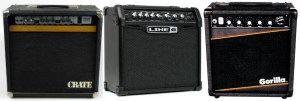
First of all, you’re not an idiot for turning down the mid when dialing in your sound. On a lot of inexpensive amps, the mid knob mostly controls lower mid which sounds awful when turned up. The frequencies that are going to make you cut through the mix are in the upper mid range.
Also, if you listened to a few recordings for reference, the overall mix of the whole band was probably somewhat mid-scooped. You’ve tried to emulate that with your guitar sound, which is understandable.
Probably the best approach would be to set all your EQ knobs to 12 o’clock, have your band make a lot of noise, hit a chord and then make subtle adjustments until you get a sound you like.
When you do this, you might be surprised how little bottom end you need. It doesn’t cut through the mix anyway and might be muddying up your sound. I’ve heard it said that some sound guys will drop the bottom end right down on the guitar channel of their mixer before they’ve heard you play a note. If you tune right down for heavy music, rest assured your sound will be bottom heavy anyway because of your tuning. Be low in pitch, not EQ.
Gain and Compression
When you add gain, you also add compression. With compression, the loudest parts of your sound get quieter, and the quiet parts of your sound get louder.
Those quiet frequencies suddenly getting turned up plays a big role in why we like high gain sounds. There’s a lot more easily observable harmonic content, so the whole thing sounds rich and complex, like a whole orchestra coming out of your guitar. Also, with more of your guitar’s frequencies lifted (and kept up) by this compression, it takes a lot longer for a note to fade out.
So we have a sound that’s full, rich, and sustaining for days. Where’s the problem? Well the louder frequencies have also gotten quieter and your overall sound is perceived as being smaller.
We get so used to the idea that turning up the gain introduces more clipping, that we expect our sound to get bigger and more aggressive the more we turn it up. Doing so turns up your compression which actually contributes to a quieter sound. Aint that a kick in the pants?
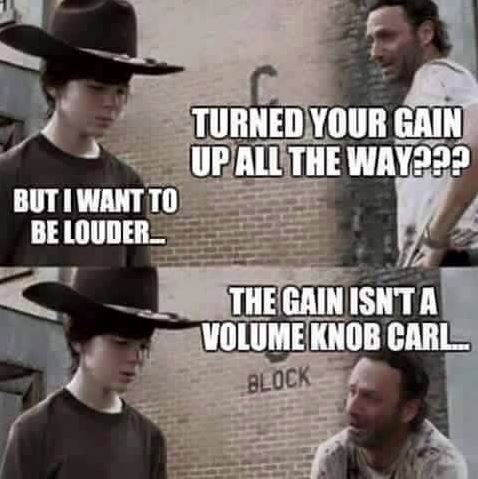
As with setting your EQ knobs, you’d be well served to set your gain knob while your band makes a racket. Start down low and roll it up to taste, remembering to only use as much as you feel you need. Cranking it all the way up is pointless and silly, as it will do nothing to increase your volume or testicular diameter.
So that’s where your sound went. You’ve started with a nice big uncompressed clean tone, turned on your distortion and suddenly all that compression has squeezed your signal to a shadow of its former self. Your only hope of being heard was if your EQ had some obnoxiously high mids dialed in, but chances are you scooped those out.
Balancing clean and dirty sounds.
It’s possible to use the power of compression for good instead of evil. Adding a little to your clean sound will add some much needed sustain, and smooth out your transients. Transients are those little spikes in volume that happen when you hit one note louder than another.
A funny thing happens in the ears of audience members when they hear these transients. Their perception of your overall volume is arrived at by taking the average of your regular guitar signal and these transients. It feels like you’re louder than you actually are.
So when you turn on your overdrive and introduce compression (utterly squashing those transients into line), it feels as though you’ve gone from a loud clean sound to a quiet dirty one. The solution here is to turn down the gain on your dirty sound and add compression to your clean sound.
The obvious way to do this would be to use a compression pedal for your clean sound. The not so obvious way is to leave your overdrive on all the time, and flip between dirty and clean sounds by rolling your guitar’s volume knob up and down.
Using a boost for solos
So you’ve compressed your clean sound, and tweaked your gain and EQ for your dirty sounds, but you’re still having trouble getting heard when you play leads.
The answer here is to have a boost that you turn on when you take a solo. This could be a separate setting on a multi-channel high-gain amp, or a boost pedal.
A good solo tone is one you can hear
Mick & Dan, “That Pedal Show”
Be prepared to dial in a sound you wouldn’t ordinarily lean on too much so that your quieter single note playing can cut through the mix better.
Your boosted sound should typically have much less bottom end, heaps more mids, a bold amount of high end, and a subtle increase in overall volume level. If you were on your own and strumming chords, this might sound positively revolting. In a full band setting while you rip out a solo, it’s surprisingly effective.
 Tone Quest
One thought on “Tips for working with overdrive and distortion”