If you’re on a tight budget but have found yourself hooked on pedal acquisition, you’ve no doubt discovered the wonderful world of “clones”. Thanks to a peculiar quirk in intellectual property law, it’s the look of a pedal and its name that you’re not allowed to replicate. You’re free to copy the circuit to your heart’s content.
Disclaimer:
Just to be clear, I’m not a lawyer, and this is my feeble, uneducated understanding of the matter. If you choose to do this you do so at your own risk. Please chime in on the comments section if you know what’s actually going on here.
The important distinction to make is that I’m not talking about counterfeits. I’m talking about pedals that are assembled in different enclosures and marketed with different names. Counterfeits do exist, but that’s not what I’m referring to here.
Anyway, cloning makes perfect sense in some cases. There are pedals like the Klon Centaur and Marshall Bluesbreaker that are long out of production, and can only bought for “collectors” prices. If the original manufacturer no longer makes them, where’s the harm in someone else having a go?
There’s a somewhat ethical grey area after that. There are boutique pedal manufacturers who build everything by hand, carefully measuring and choosing every component with painstaking quality control. They charge a fair price for such effort and craftsmanship, which happens to be more than most folks want to pay for a mere tonal tool.
With this approach comes a long waiting list for your pedal to be made. Analogman’s King of Tone notoriously has a 2-3 year waiting list. So if you can’t stomach the wait, you might want to consider the used market. Knowing the waiting list creates scarcity, used versions of these sell for highly inflated collectors prices.
What’s an impatient, cash-strapped muso to do? Clones of these pedals which are available for a small fraction of the price get awful tempting. You might justify it by thinking that the original manufacturer is already selling more than they can make, so they’re not missing out on sales. After all, is a mass-produced cheapo unit really competing with hand built boutique pedals?
I’m not going to weigh in here. On one hand I have massive respect for boutique builders. On the other, I have a modest income, yet would still like to participate in the pursuit of guitar tone. So whether you throw stones from your ivory tower in defense of boutique builders, or bypass the builder and gather cheap imitations without regard, I’m not here to judge. You do you.
Are clones as good as the real deal?
Yes and no. On the one hand they typically have the same circuit, and as such will (in theory) sound and function exactly the same. In order to mass manufacture something at a cheaper price point, quality control corners often get cut and cheaper components become a must.
Ironically enough, the cheapest generic brand pedals tend to be closest to the original circuits. They’re not looking to re-invent the wheel, so going with what’s already there is a quick and easy solution. In the meantime, mid-priced brand name pedal manufacturers tend to want to make their own pedal, merely inspired by the original. Their own spin on it might be better, worse, or just plain different.
A great example is the EHX Soul Food. Inspired by the Klon Centaur, opinions all over the net are divided over whether it differs too much with its brash high frequencies, or whether it’s a welcome fresh take on the original. Meanwhile, the Mosky Golden Horse gets universally praised for doing more or less exactly what a Klon should, for around half the price of the Soul Food.

In my quest for a decent uni-vibe style pedal at a budget price, I discovered the Animal Pedals Car Crush. Animal Pedals are put out by One Control who are best known for making respectable, mid-priced loop switchers. The Car Crush was the cheapest vibe pedal I was aware of that made use of a photo cell circuit.
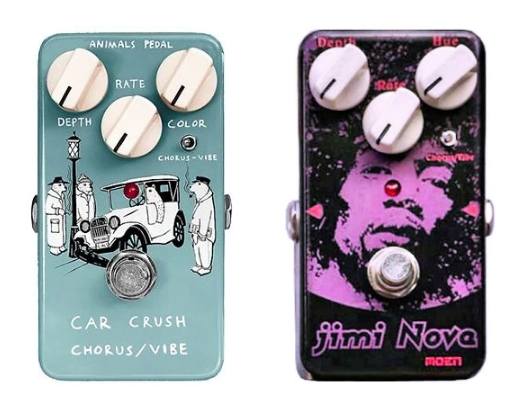
I asked online for recommendations for other cheap photo cell vibes, and if anyone had experience with this one. One helpful soul opened his much cheaper vibe pedal, the Moen “Jimi Nova“, and compared it to the innards of a Car Crush. Wouldn’t you know it, they’re the same pedal, but the Moen one costs half the price.

The artwork on the Car Crush is way cooler, and you might have some of your peers turn their noses up at the sight of a generic Moen pedal on your board. Whether it’s worth twice the price to rectify that is a question for your conscience.
What do I need to be concerned about with cheaper pedals?
Moving parts
The most obvious things that can go wrong with any device will likely involve moving parts. Check for flimsy switches, and free-spinning knobs that do nothing to affect the sound. Make sure the input and output jacks are ok.
Power
If you plug a switched on power lead into a pedal, the split second before a firm connection is made could result in a bit of a power spike through the pedal. More expensive pedals will likely have some small amount of protection built in, while the cheaper ones will end up fried before you’ve played a note.
I’ve heard anecdotes of this happening to Mosky pedals in particular. If all the generic brands are using the same circuits, they’ll all likely be just as susceptible.
Best practice is to plug your power in first, THEN switch the power on. Still, it’s nice to know if the connection wasn’t as firm as you thought it was, you haven’t killed your pedal.
Noise
This is particularly a problem for pedals with plastic enclosures that aren’t well shielded. That’s not to say all plastic pedals suffer from this, but they are the main culprits.
There are also some pedals which function with a high noise floor. You might consider fixing this with a noise gate, or spending a little more money on the original purchase and finding a better version without so much noise. Then again, maybe your tolerance to the noise makes it not a problem. This is just something to weigh up when trying cheap pedals.
The Bottom line
Nothing comes close to the quality control, aftermarket service, and sense of community you find when you purchase a top end pedal. The expression “buy cheap, buy twice” definitely holds true here as well. Then again, you shouldn’t let a tight budget stand in the way of getting amongst it while cheaper options are available.
 Tone Quest